Anyone who bought a laptop or built a gaming PC this year already felt memory prices climb. DRAM and NAND flash have gotten steadily more expensive as AI data centers absorb nearly every chip factories can produce, according to a Bloomberg analysis.
On August 3, SK hynix and Sandisk released the technical specification for a new memory category built to ease that exact scarcity, but the more interesting fight is over whose version of the fix becomes the industry standard.
SK hynix, which also trades in the U.S. under the ticker SKHY, is the world’s second-largest memory chipmaker and a dominant supplier of HBM for Nvidia’s AI accelerators.
Sandisk, trading as SNDK on the Nasdaq, spun off from Western Digital last year and specializes in NAND flash, competing directly with Samsung and Kioxia. Both stocks have surged over the past year as AI infrastructure spending has strained memory supply.
Related: SK Hynix denies Intel Ohio fab deal, but the market didn’t care
The specification, called High Bandwidth Flash, defines a new memory tier positioned between HBM and solid-state drives, according to a joint statement from Sandisk and SK hynix.
It supports capacity up to 512 gigabytes across stacks of eight or 16 NAND dies, with bandwidth split into three grades running from roughly 0.4 to 3.0 terabytes per second.
No shipping product today combines flash-level capacity with anything close to HBM-level speed.
HBM is fast because it stacks DRAM directly next to the processor, but DRAM is costly and limited in how much it can be packed.
Solid state drives hold far more data for a fraction of the price, yet they are too slow for accelerators pulling live model data mid-inference. While AI training is building the model, inference is the process of running it live to generate responses for users.
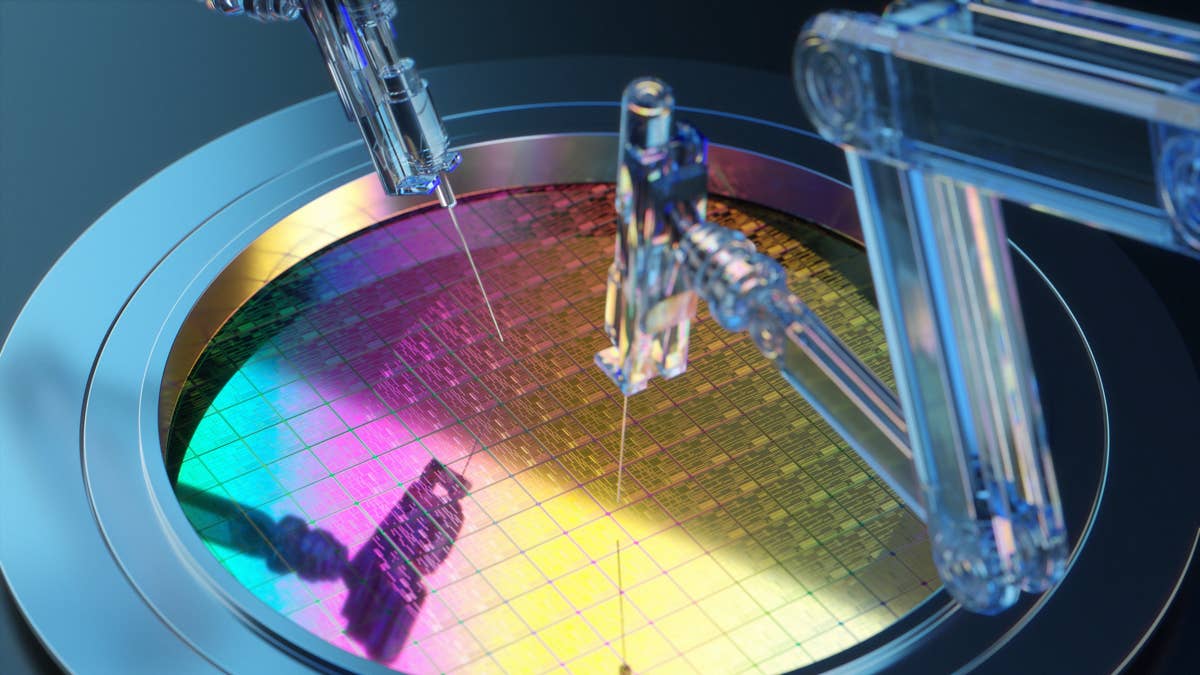
High Bandwidth Flash is designed to sit between the two, letting AI systems hold larger models closer to the chip without the delay of reaching for storage.
Sandisk’s own roadmap has targeted initial HBF samples for the second half of 2026, with AI inference products following in early 2027, according to the company’s original announcement of the partnership. That puts real revenue at least a year away.
Yuichiro Chino / Getty Images
An open standard nobody has to license
Google and Tenstorrent joined as consortium members during the standardization process, according to Sandisk’s release.
SK hynix and Sandisk published the specification through the Open Compute Project, an open industry framework, rather than keeping it proprietary, according to the Korea Herald.
Letting any chipmaker build around a free specification is the fastest way to make it the default before a rival approach gains traction.
Samsung and Kioxia are building rivals
Samsung is expected to unveil its own next-generation architecture, called zHBM, at the same FMS 2026 conference this week, according to a BigGo Finance report.
Unlike HBF, zHBM stacks memory directly on top of the GPU rather than beside it, and it sits outside the SK hynix and Sandisk consortium entirely.
Samsung remains the world’s largest NAND flash maker, giving it enough scale to push a competing approach regardless of which standard the rest of the industry adopts.
Kioxia has taken a third path. The Japanese memory maker built a prototype High Bandwidth Flash module with 5 terabytes of capacity and 64 gigabytes per second of bandwidth over a PCIe interface, according to Kioxia’s own announcement.
That is a different connection standard than the UCIe interface SK hynix and Sandisk chose, so products built for one spec will not work with the other. For investors, that fragmentation is the risk sitting underneath an otherwise exciting technology story.
Why the stock reaction undersells the news
SK hynix (SKHY) and Sandisk (SNDK) shares gained roughly 3% in extended trading after the announcement.
That reaction is hard to separate from timing. Sandisk reports fiscal fourth quarter earnings on August 5, just two days later, and the stock has swung between roughly $40 and $2,354 over the past year, a sign of how volatile memory names have become.
SK hynix shares fell more than 9% in late July after a record quarter still missed revenue estimates, CNBC reported.
More SK Hynix:
- Jim Cramer’s cryptic comments on key AI supplier turn heads
- SK Hynix denies Intel Ohio fab deal, but the market didn’t care
- SK Hynix is testing the limits of Wall Street’s ETF boom
Memory standards are becoming a competitive weapon
The bigger story here is not a single spec sheet. Hyperscaler capital spending on AI infrastructure is on pace to exceed a trillion dollars this year, according to Deloitte, and memory makers are racing to make sure the architecture customers design around is theirs.
That is what happened with HBM, where early movers locked in years of advantage before rivals caught up. High Bandwidth Flash is shaping up as the same fight one generation earlier, and this week’s competing announcements out of Santa Clara suggest nobody has agreed yet on which version wins.
For investors, the signal to watch is which GPU and hyperscaler partners standardize on which interface once products ship next year.
Related: Down 45%, is SanDisk stock a bargain buy or value trap?