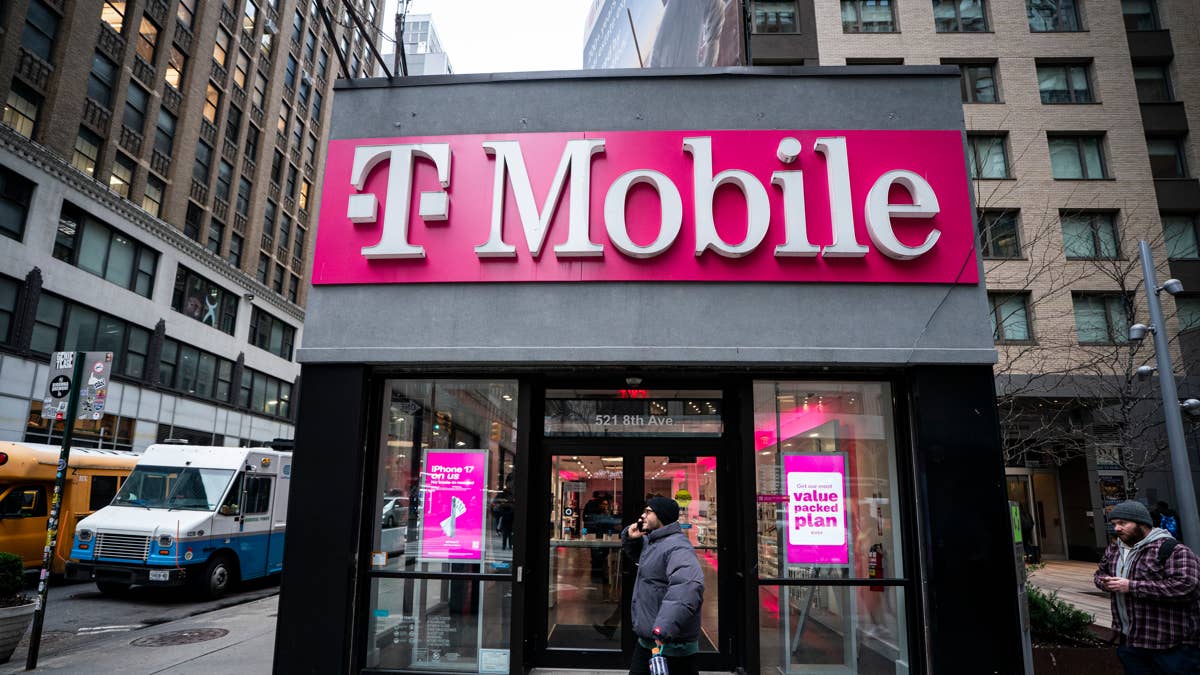
The fight over who gets to beam cell service from space just got personal. In an Oct. 28 letter to the Federal Communications Commission, Elon Musk’s SpaceX accused legacy carriers, including T-Mobile, of opposing new spectrum rules out of a “misplaced desire to harm a competitor.”
SpaceX said the updated rules would bring direct-to-cell service to underserved border communities, according to TheStreet.
The tone stands out because the two companies are still partners. SpaceX told regulators it “has worked extensively with other operators, including T-Mobile.”
Yet T-Mobile quietly removed Starlink’s name from its main T-Satellite page in October. The clash shows how quickly a partnership can turn tense once both sides want the same customers.
Also read: Verizon CEO lays out one condition for a Starlink partnership
SpaceX takes its case to the FCC over spectrum rule changes
At the heart of the dispute are proposed limits on satellite power. SpaceX urged the FCC to reject what it called “technically unsound recommendations” from T-Mobile and the Aerospace and Flight Test Radio Coordinating Council, which argue that satellite signals could interfere with flight telemetry tracking systems.
SpaceX did not hold back on the aviation group. “AFTRCC is now purely a lobbying organization whose mission is to protect legacy companies, and their comments should not be viewed as independent or objective,” the company wrote, as reported by Benzinga. In short, SpaceX framed the group as a voice for incumbents rather than a neutral referee.
The timing also matters, since the FCC proposed on Oct. 29 to add 482 MHz of spectrum for satellite-to-phone service, while carriers have asked to strip out the 2.5 GHz and 3.45 GHz bands, or 290 MHz, according to TheStreet.
SpaceX also went after T-Mobile’s request to protect its cell towers. The company said those demands would create 250-mile-wide buffer zones around base stations, “disenfranchising millions from direct-to-cell service in the countries where the limit is applied.”
Carriers push back on satellite signals
T-Mobile sees real risk to its own network, Light Reading noted. The carrier warned that satellite signals could wipe out up to 96% of a cell site’s uplink coverage area and cut uplink speeds by 88% to 99%. Those figures help explain why the carrier wants tighter limits on satellite power.
Its CEO is also drawing clear limits on the relationship. On T-Mobile’s Oct. 28 earnings call, Srini Gopalan said the company sees satellite as “a complementary product” and does not “really see the room for an MVNO for satellite or SpaceX.”
He also rejected using satellite to bolster T-Mobile’s fixed wireless internet business, calling it an inferior option outside deep rural areas, TheStreet reported.
The big three carriers are also teaming up. AT&T, T-Mobile, and Verizon formed a joint venture focused on satellite technologies to close coverage gaps, especially in unserved and underserved areas, and said it could “nearly eliminate dead zones” in the U.S.
Verizon CEO Dan Schulman said the partnership “increases competition for satellite providers.”
The lobbying is playing out in Washington, too. Gopalan met separately with FCC Chairman Brendan Carr and has described direct-to-cell service as “a complementary category.”
That puts the carriers and SpaceX on very different sides of the same rulemaking.
Al Drago / Getty Images
SpaceX’s bigger wireless ambitions
The spectrum fight is about more than satellite texting. SpaceX bought 65 MHz of spectrum from EchoStar, giving it about 70 MHz in total when combined with the roughly 5 MHz it uses through its T-Mobile partnership, still far less than the big carriers hold.
Its planned next-generation Starlink Mobile V2 satellites are expected to follow, and President Gwynne Shotwell said the service will be “100 times better” than the current offering, TheStreet reported.
The plan also leans on small ground equipment. Shotwell described putting a cellular base station on the hardware that holds a Starlink broadband dish, creating small femtocells that can be added as needed rather than building large towers. SpaceX has not yet shown it can match the density of carrier towers in cities and suburbs.
Rival executives say that path will be costly. Verizon’s Schulman put the price of competing with traditional carriers at “somewhere between $300 billion and half a trillion” dollars, and said it would take a minimum of four to six years to fully build that out. Matching the carriers would mean covering roughly 65,000 to 80,000 macro cell sites.
More SpaceX:
- Goldman Sachs revamps SpaceX stock estimates before crucial earnings test
- Musk called Anthropic ‘evil’; SpaceX’s deal with it nearly doubled
- Morgan Stanley doubles down on SpaceX stock verdict for investors
AT&T is also skeptical. CEO John Stankey told Axios that building that capability would cost about as much as a macro network and noted that companies “can’t radiate cellular signals from somebody’s house without their permission.”
He also argued that “nothing beats” fiber, as reported by Benzinga.
The physics debate behind the fight
T-Mobile’s finance chief thinks the laws of nature favor the carriers. “You can have a million satellites up there with all the spectrum in the world,” but “you can’t break the fundamental laws of physics,” CFO Pete Osvaldik said, speaking at Citigroup’s Global TMT Conference in September.
He argued that satellite signals weaken badly over distance, especially indoors, and called Starlink “not a competitive threat” from a wireless standpoint. He added that SpaceX would likely need “probably over a billion femtocells” to match carrier coverage.
Still, he said Starlink could challenge broadband in rural and suburban areas, according to Benzinga.
For now, the rivals remain tied together. T-Mobile launched its T-Satellite service with SpaceX in July 2025, and it now runs on more than 650 Starlink satellites for $10 a month as an add-on.
Gopalan said he is “very happy to look at a resale arrangement” if satellite stays a complementary product. How the FCC rules on power limits may decide how far that partnership can stretch.
Related: Elon Musk sends a strong memo to SpaceX and Tesla stock investors