You leave dinner, open Uber Technologies (UBER), and hesitate at the fare and think about whether the ride home is worth that much?
For Uber app users like myself, that’s a pretty familiar calculation. For the company and its stock, those decisions can shape its growth trajectory.
Here’s the twist though, Uber says lower insurance costs have helped make rides more affordable in one market, lifting demand. In other places, high fuel prices and a shortage of drivers are pulling in the opposite direction.
The same app can look like a bargain in one city and a splurge in another, fueling a pricing paradox.
Naturally, that uneven picture caught Wall Street’s attention. After Uber reported quarterly earnings, Bank of America analyst Justin Post cut his price target on Uber stock, though he kept his Buy rating.
The cut raises a broader question about whose costs are falling, whose are climbing, and how long Uber can profitably balance both.
Jemal Countess / Getty Images
Bank of America cuts Uber stock target after mixed earnings
Bank of America is essentially questioning what Uber’s ongoing growth could potentially cost.
In a November 4 report following Uber’s Q3 earnings, analyst Justin Post slashed his price target on Uber stock to $98 from $101, a 3% reduction. He maintained his Buy rating. Compared with Uber’s November 5 closing price of $68.78, the revised target still implies about 42.5% upside.
- Goldman Sachs resets Nike stock price target after brand disappoints
- Morgan Stanley resets AMAT stock price target by $79
- Bank of America resets AMD price target after major milestone
“We lower our PO to $98 (from $101) based on a lower 2027E EPS and an unchanged 23x multiple,” Post wrote.
Put simply, it wasn’t like Post felt Uber deserved a cheaper valuation. He reduced his estimate for what it could earn. BofA’s 2027 adjusted earnings forecast slipped to $4.24 a share from $4.35.
Uber’s Q3 results put that caution on display, recording $59.8 billion in gross bookings, $14.8 billion in revenue and $3 billion in adjusted EBITDA. Moreover, adjusted earnings rose 35% to $0.88 a share. But ride-hailing bookings of $29.5 billion fell short of Wall Street’s $29.9 billion expectation. Delivery bookings, at $28.5 billion, exceeded estimates.
Investors got mixed signals, though. Shares climbed 4.9% on November 4, then lost 1.6% the next day. They were still down roughly 16% in 2026, leaving Uber trading at a substantially lower earnings multiple despite the relatively impressive quarterly showing.
For Uber, finding enough drivers at the right cost is getting harder, creating a delicate balance between what riders will pay and what drivers need to earn. That tension is where the rider-price paradox begins.
Why cheaper Uber rides come with an unexpected trade-off
An Uber ride can get a lot cheaper without the company finding it easier to make money.
Bank of America’s November 4 report points to California, where insurance savings passed to customers helped significantly accelerate growth in trips.
Cheaper fares can turn a ride from an occasional convenience into a more frequent habit. However, those savings came with a trade-off.
Under California’s SB 371, required uninsured and underinsured motorist coverage fell from $1 million to $60,000 per person and $300,000 per accident. The separate $1 million liability requirement remains.
Moreover, lower operating costs don’t guarantee lower bills. CalMatters reported in June that independent Gridwise data showed California fares were mostly flat or higher year over year through May, apart from a small decline that month.
Elsewhere, the pressure runs backward.
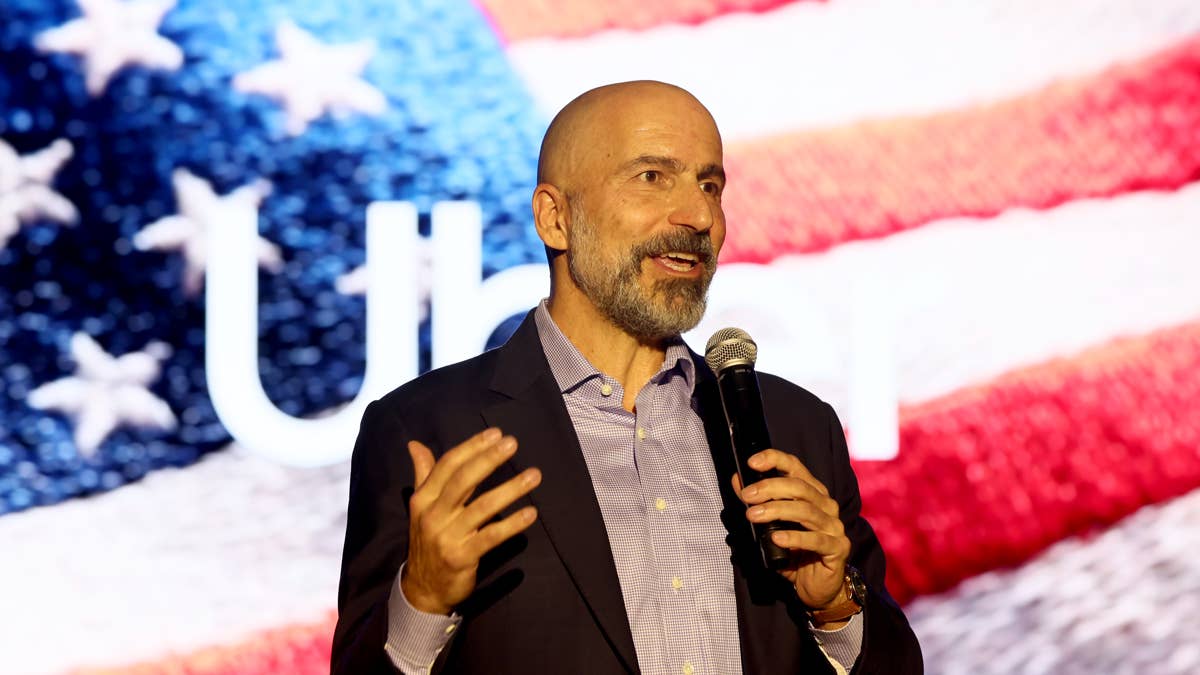
Higher fuel costs and driver shortages have compelled Uber to work harder to keep cars available. CEO Dara Khosrowshahi said Uber was shifting incentives from riders to drivers.
“Now that does mean sometimes higher prices for riders,” he acknowledged.
That’s a paradox for riders and investors, as Uber needs affordable trips to efficiently drive demand, but enough driver pay to deliver them profitably at scale.
What the rider-price paradox means for Uber stock investors
Uber’s next big test is keeping drivers available without forcing fares higher or sacrificing profits.
In the upcoming quarter, Uber is expecting $63.25 billion to $65.25 billion in gross bookings and $3.13 billion to $3.23 billion in adjusted EBITDA. Incentives could sustain trips but, in time, pressure margins.
As my colleague Mwangi Enos reported for TheStreet, CEO Dara Khosrowshahi told CNBC that demand currently exceeds available drivers, even as Uber starts resisting raising customer prices.
That limits its room to maneuver.
Still, BofA’s Justin Post sees value. Uber trades around 11 times projected 2027 EBITDA, near historical lows, while BofA expects $12.4 billion in free cash flow next year.
Moreover, according to Seeking Alpha it trades at 2.43-times forward sales, 16% lower than its 5-year average, but 42% higher than the sector median.
“We think facilitating the AV ecosystem is a good use of Uber’s cash flow, but expect some concerns on potential for future cost pressures,” Post wrote.
Uber targets 700 fully driverless cars by year-end and more than 2,000 in 2027. Competition from Waymo and Tesla (TSLA) makes that an expensive, gradual fix.
For investors, watch trips, rider fares and margins together. Better driver supply without pricier rides could potentially justify a higher valuation. Moreover, rising incentives and slower bookings could bring another earnings reset.
Related: Mark Cuban says CVS breakup may not make prescriptions more affordable