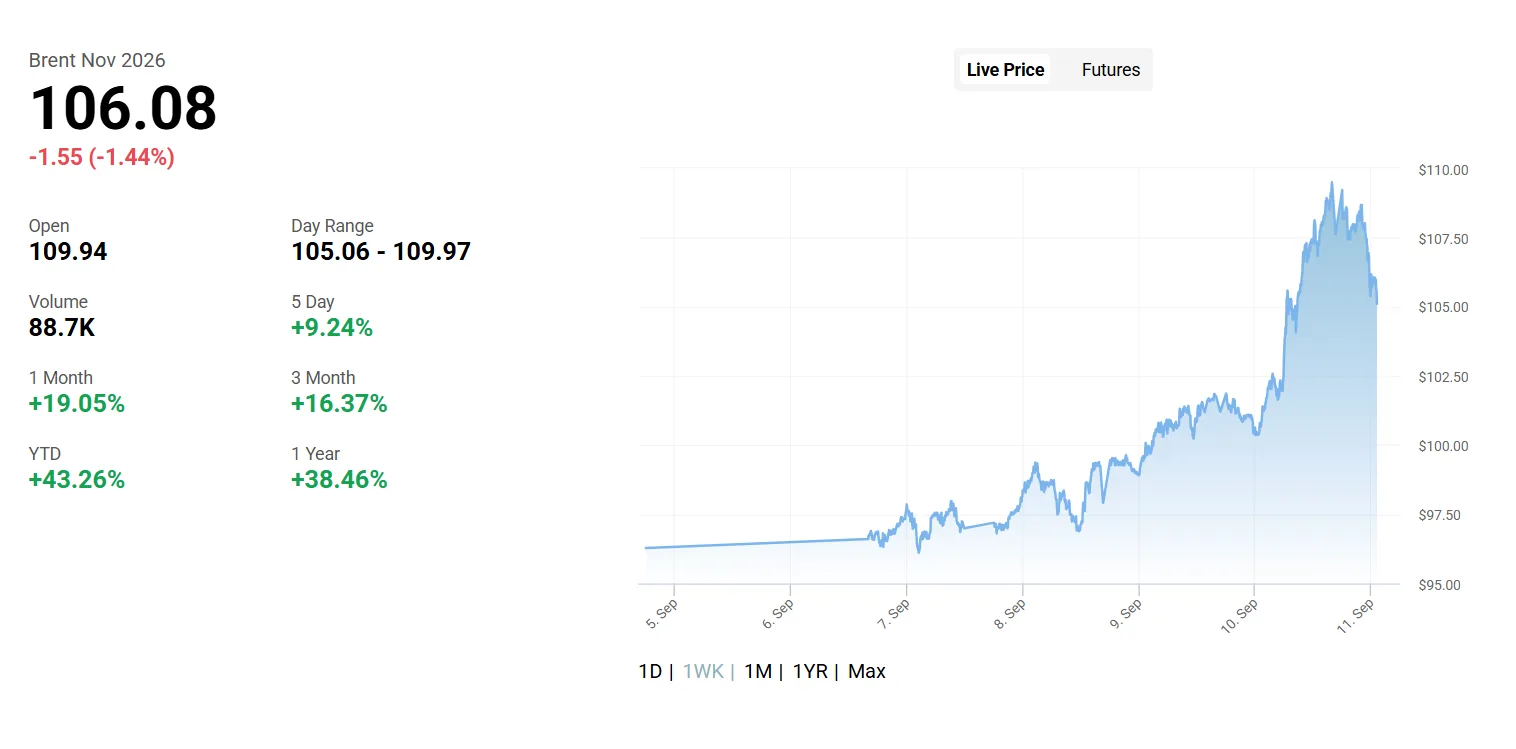
Updated 12 September 2026. Brent crude settled at $104.61 a barrel, down $3.02 or 2.81% on the day, and WTI at $100.05, down 2.37% (OilPrice.com and Trading Economics, 11 September close). Brent still finished the week up around 9%. Verdict: the number went down on Friday and the risk went up. Houthi forces took Perim Island, the rock that splits the Bab el-Mandeb into its two shipping lanes, and in the same 48 hours the Saudi pipeline that exists to route crude around the Strait of Hormuz was struck and shut. The two chokepoints on the same barrel are now both contested, and the pullback in price is a weekend position adjustment, not a resolution.
Key facts
- Perim Island fell on Friday 11 September. Iran-aligned Houthi forces seized the island at the southern mouth of the Red Sea after Saudi-backed government forces withdrew, according to four Yemeni government sources who spoke to Reuters (reported by France 24 and NBC News, 11 September). Perim divides the Bab el-Mandeb into two navigable lanes, which is why it is the piece that matters.
- It was the third capture in two days. The port city of Mocha fell on Thursday 10 September, and the Houthis also took the mainland coastal town of Dhubab and the Hanish islands – the positions directly opposite Perim on the strait.
- Saudi Arabia’s Hormuz workaround was hit at the same time. Satellite imagery verified by Reuters showed smoke along the East-West pipeline on Thursday, and Saudi state media said the line was temporarily shut after attacks that caused injuries. NBC News reported a roughly 60-mile smoke plume south of Medina.
- That pipeline is the reason Bab el-Mandeb volumes exploded. Crude and petroleum liquids through the strait averaged 8.1 million barrels a day in the second quarter of 2026, up from 5.4 million a day in the fourth quarter of 2025, while Hormuz flows collapsed from 21.6 million to about 4.9 million b/d (U.S. Energy Information Administration, Short-Term Energy Outlook). The EIA attributes the Red Sea increase in part to Saudi Arabia rerouting crude through the East-West pipeline to Yanbu.
- Saudi supply is already at a three-decade low. Saudi crude supply fell to about 6 million b/d in August, the lowest in more than thirty years (France 24).
- Washington has so far declined to intervene directly. Crown Prince Mohammed bin Salman called President Trump twice on Thursday to request U.S. military assistance, and did not get it (France 24, citing Reuters reporting).
- The Houthis have named their exemption. The group said maritime navigation is safe for all companies except Saudi vessels, and military spokesman Yahya Saree said the group will “continue to enforce blockade for blockade and escalation for escalation until the aggression stops.”
What changed on Friday, specifically
FinanceFeeds covered the Mocha capture and the approach to the strait on 11 September in Houthis Seized Mocha and the Crude Oil Price Crossed $100 as a Second Chokepoint Comes Into Play. At the time of that piece, government forces had pulled back to Dhubab, on the strait directly opposite Perim, and Yemeni military sources were describing Dhubab and Perim as the keys to the strait itself.
Both of those keys have now been handed over. Dhubab was taken, then Perim. A force that holds Mocha, Dhubab, the Hanish islands and Perim holds the eastern side of an 18-mile-wide passage and the island that splits its traffic. That is a materially different military position from holding a port 60 miles up the coast, and it is the change that the price has not yet fully absorbed.
Why the pipeline strike matters more than the island
The island is the headline. The pipeline is the mechanism.
Saudi Arabia’s answer to a constrained Strait of Hormuz has been the East-West pipeline, which moves crude from the Eastern Province across the country to Yanbu on the Red Sea, where it can be loaded and shipped out through Bab el-Mandeb. That is precisely the substitution the EIA measured: Hormuz down from 21.6 million b/d to roughly 4.9 million, Bab el-Mandeb up from 5.4 million to 8.1 million. The barrels did not disappear, they changed doors.
Striking the pipeline and taking the strait are therefore the same operation from two directions. One closes the door, the other cuts the corridor leading to it. Saudi crude supply already running at a three-decade low of about 6 million b/d tells you the substitution was not costless even before this week.
What the analysts are actually saying
Andreas Krieg of King’s College London, quoted by NBC News, supplied the necessary caution: full Houthi control of Bab el-Mandeb remains unlikely because “the western littoral remains outside Yemen” – the Djibouti and Eritrea side of the passage is not theirs to take. What the captured ground does provide, in his words, is “a dramatically stronger ability to contest, threaten and potentially deny commercial use.”
That is the honest framing. This is not a closed strait. It is a strait where the cost of insuring and routing a cargo just went up again, and where a single incident now has a shorter path to becoming a stoppage.
Brent scenarios from here
A caution on the numbers below: the bear and base anchors are full-year 2026 average forecasts, which is why they sit below a crisis spot price, while the bull anchor is a scenario level. They are not directly comparable to each other and none of them is a price target for this month. They are included because they mark where serious desks think the range sits.
| Scenario | Brent level | Named anchor | What has to happen |
|---|---|---|---|
| Bear | $85-90 (below the $104.61 spot) | Goldman Sachs raised its 2026 Brent average forecast to $85 as its base case; HSBC lifted its 2026 Brent forecast to $90 from $80. JPMorgan has been the outlier low, holding a full-year baseline near $60 on the view that protracted disruption is unlikely. | A negotiated pause, the East-West pipeline back in service, and tankers resuming Red Sea transits without a war-risk surcharge. Nothing announced this week points that way. |
| Base | $100-110 | The market’s own current pricing: Brent $104.61, WTI $100.05 at Friday’s close, after a $107.63 close on Thursday (Investing.com). | The strait stays contested but transited, Saudi loadings at Yanbu continue at reduced volume, and no tanker is actually hit. This is the path of least resistance. |
| Bull | $120-130 | Goldman Sachs has outlined upside above $120 a barrel if Hormuz flows stay severely restricted through the third quarter. Barchart has separately laid out a case for $130. | An actual interdiction in Bab el-Mandeb, or a second successful strike on Saudi export infrastructure. With both chokepoints on the same route compromised, there is no third door. |
What to watch next
- Whether the East-West pipeline restarts, and at what rate. Saudi state media called the shutdown temporary. A prolonged outage takes Saudi Red Sea loadings down and removes the substitution the EIA measured.
- War-risk insurance quotes for Bab el-Mandeb transits. This is the mechanism by which a territorial change becomes a freight cost and then a crude price. It moves before the shipping data does.
- The first test of the Saudi-vessel exemption. The Houthis have said navigation is safe except for Saudi ships. Whether that distinction is enforced or ignored determines whether this is a targeted blockade or a general one.
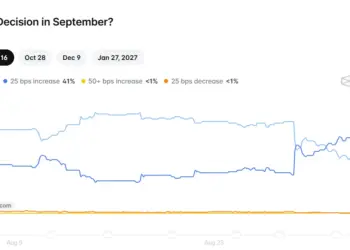
- The FOMC on 16 September. Brent above $100 is now a live input to the U.S. inflation forecast, and the Fed decides on Wednesday with a hike priced at 79.5% on Polymarket and near 86% on CME FedWatch, with August CPI at 3.4%. The energy channel and the rates channel have merged.
Quick take: Brent fell 2.81% to $104.61 on Friday and still closed the week up about 9%, which tells you the market is trading the level rather than the news flow. The news flow got worse: the Houthis now hold Perim Island and the ground opposite it, and the Saudi pipeline built to bypass Hormuz was struck and shut in the same week. The EIA’s own numbers show 8.1 million barrels a day moved to this strait precisely because the other one was constrained. Two compromised chokepoints on one route do not add, they compound – and the honest analyst read, per King’s College London, is not that the strait is closed but that it can now be contested at will.
Frequently asked questions
What is Perim Island and why does it matter for oil prices?
Perim, also called Mayun, is an island in the Bab el-Mandeb Strait at the southern entrance to the Red Sea. It sits in the middle of the passage and divides it into two navigable shipping lanes, which means whoever holds it is positioned on both. Houthi forces captured it on Friday 11 September 2026 after government forces withdrew.
How much oil goes through Bab el-Mandeb?
Crude oil and petroleum liquids through the strait averaged 8.1 million barrels a day in the second quarter of 2026, up from 5.4 million a day in the fourth quarter of 2025, according to the EIA’s Short-Term Energy Outlook. The increase came largely from cargoes rerouted away from the Strait of Hormuz.
What is the crude oil price today?
Brent crude settled at $104.61 a barrel and WTI at $100.05 at the 11 September 2026 close, per OilPrice.com and Trading Economics. Brent was down 2.81% on the day and up roughly 9% on the week.
Have the Houthis closed the Bab el-Mandeb Strait?
No. They have said navigation is safe for all companies except Saudi vessels. Andreas Krieg of King’s College London told NBC News that full control remains unlikely because the western side of the passage, along Djibouti and Eritrea, is outside Yemen – but that the captured positions give the group a far stronger ability to contest and potentially deny commercial use.
Why does the Saudi East-West pipeline matter here?
It carries crude from Saudi Arabia’s Eastern Province to the Red Sea port of Yanbu, allowing exports to avoid the Strait of Hormuz entirely. The EIA credits it as a reason Bab el-Mandeb volumes rose. Saudi state media said the pipeline was temporarily shut this week after attacks, with Reuters-verified satellite imagery showing smoke along its route.
Could oil reach $120 or higher?
Goldman Sachs has set out an above-$120 scenario if Hormuz flows remain severely restricted through the third quarter, and Barchart has published a case for $130. Both are conditional scenarios rather than base-case forecasts. Goldman’s own 2026 base case average is $85, and HSBC’s is $90.
Is the United States getting involved?
Not directly so far. France 24 reported that Crown Prince Mohammed bin Salman called President Trump twice on Thursday 10 September to request U.S. military assistance and that Washington declined direct action.
Related coverage
- Houthis Seized Mocha and the Crude Oil Price Crossed $100 as a Second Chokepoint Comes Into Play – the 11 September piece this one follows up, written while Perim was still in government hands.
- WTI crude oil price: $115 bull case vs $80 bear case as Hormuz risk premium holds – the scenario framework for the first chokepoint.
- Gold at $4,385 after August CPI as hike odds run toward 90% – how the same week’s energy and inflation data landed in the metals complex.
- CPI at 3.4% and the 30-year Treasury yield at a 19-year high – the rates side of the $100 oil problem.
Sources: U.S. Energy Information Administration (Short-Term Energy Outlook, August 2026, and World Oil Transit Chokepoints); OilPrice.com and Trading Economics (Brent and WTI settlement prices, 11 September 2026); Investing.com (Thursday close); France 24 (11 September 2026); NBC News; CNN; NPR; Reuters reporting as cited by those outlets; Goldman Sachs, HSBC and JPMorgan forecasts as reported by TheStreet, OilPrice.com and Barchart.
This article is for information only and is not financial advice. FinanceFeeds does not recommend buying or selling any asset. Commodity markets carry risk, including the risk of losing more than your initial outlay. Do your own research and consider speaking to a regulated adviser before making any investment decision.