Why Is Hyundai Testing Stablecoins for Internal Payments?
Hyundai has moved a stablecoin-based internal remittance system into production readiness on the Avalanche blockchain, marking one of the clearest enterprise uses of stablecoins for cross-border treasury management by a major industrial company.
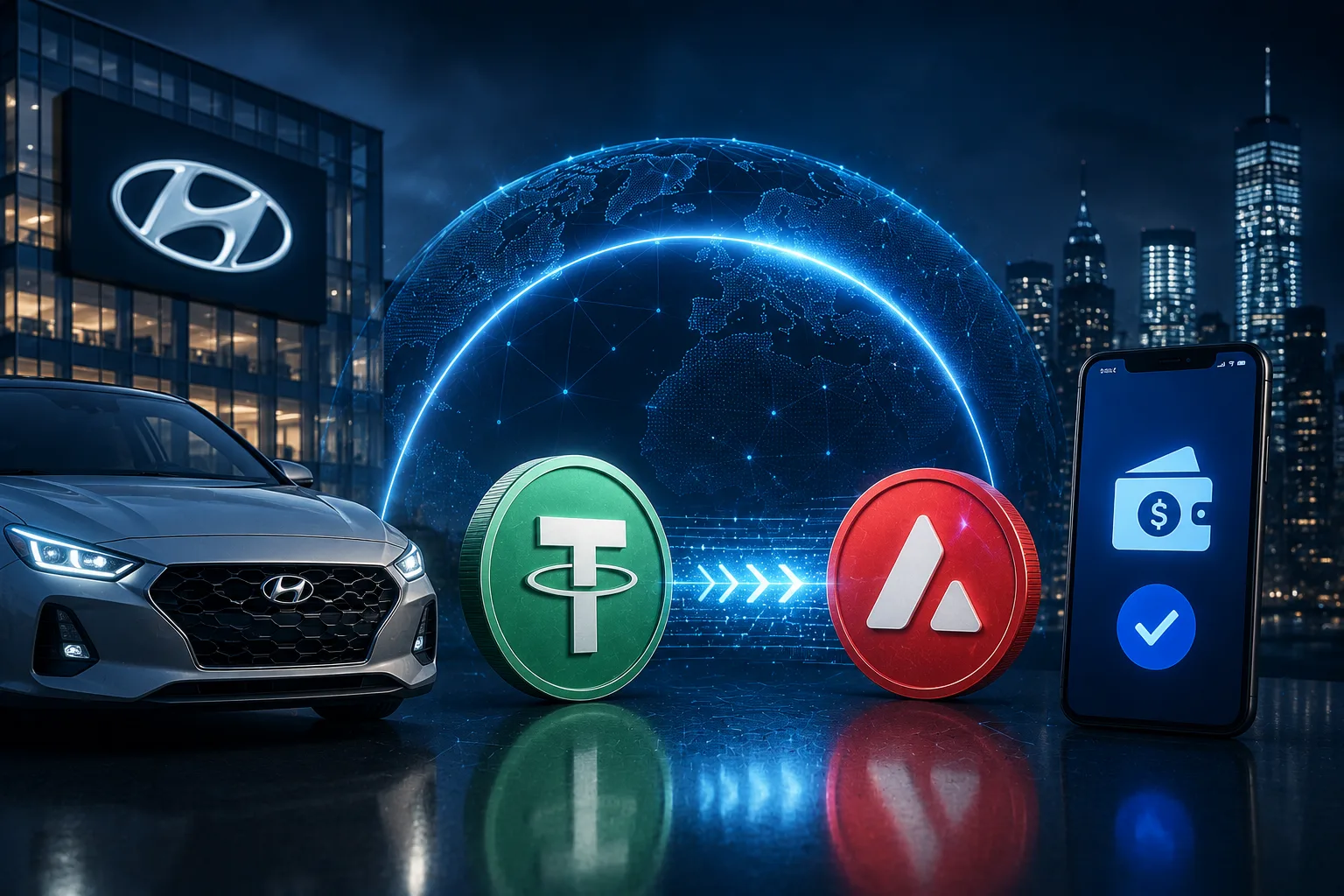
The system is designed for internal transfers between Hyundai entities rather than customer payments or crypto trading. In its first phase, Hyundai Motor America sent $20,000 to Hyundai Motor Mexico by converting dollars into Tether’s USDT stablecoin, transferring the value onchain, and converting the funds back into dollars.
The test is small in dollar terms but significant in operating context. Hyundai is the world’s third-largest carmaker by vehicle sales, and its use of stablecoins places blockchain infrastructure inside a corporate treasury workflow tied to multinational operations. That makes the project different from earlier crypto pilots focused on branding, consumer rewards, or limited proof-of-concept experiments.
Justin Kim, head of APAC at Ava Labs, said Hyundai is the first major enterprise to publicly announce this type of implementation on Avalanche. “This is already a real treasury management use case, not a sandbox — the pilot moved live USD and USDT between Hyundai Motor’s U.S. and Mexico entities,” he said.
How Does The Avalanche-Based Transfer Work?
The first transfer used a simple stablecoin remittance path. Hyundai converted dollars into USDT, moved the stablecoin between corporate entities, and then converted the funds back into dollars at the receiving end. The process was led by Hyundai Card, the carmaker’s credit card unit.
Hyundai Card said the transfer took an average of 7 minutes. That compares with the 3 to 4 hours typically required through traditional banking networks. For a multinational company, the time difference can matter when moving liquidity between subsidiaries, managing working capital, or reducing delays in cross-border settlement.
The pilot also shows why stablecoins are gaining attention outside crypto-native markets. Large companies are testing whether tokenized dollars can reduce transfer times, lower payment friction, and simplify internal treasury movement across borders. The focus is not speculation. It is whether blockchain-based settlement can compete with bank rails for specific corporate finance tasks.
Avalanche’s role is to provide the blockchain network used for the transfer. Ava Labs, which develops and supports the platform, said the project is expected to expand into additional corridors and currencies as Hyundai evaluates whether the model can scale across more enterprise use cases.
Investor Takeaway
Hyundai’s pilot points to a practical stablecoin use case: internal treasury movement between subsidiaries. The transaction size was limited, but the production-readiness framing matters because it moves stablecoins closer to corporate finance operations rather than retail crypto activity.
Why Does This Matter for Stablecoin Adoption?
Stablecoins have long been used in crypto markets for trading, liquidity, and dollar exposure. Hyundai’s project shows how the same infrastructure can be applied to corporate payments, especially where companies operate across multiple jurisdictions and currencies.
The internal remittance model could be attractive for large enterprises because it keeps the use case inside the company. That reduces some external payment complexity while still allowing the firm to test settlement speed, conversion costs, operational controls, and treasury reporting. It also gives companies a way to compare stablecoin rails against existing bank networks without immediately exposing customers or suppliers to the process.
For stablecoin issuers and blockchain networks, enterprise treasury is a high-value market because corporate payments involve large flows, recurring transactions, and strict requirements around reliability and compliance. A successful model could support demand for regulated stablecoins, blockchain settlement networks, custodial services, and foreign exchange infrastructure connected to onchain transfers.
The next phase will test whether those advantages hold beyond a single U.S.-Mexico transfer. Hyundai plans to explore additional cross-border corridors and local currencies, which should provide a clearer view of how stablecoin transfers perform when foreign exchange costs, local settlement rules, and treasury controls become more complex.
What Comes Next for Hyundai’s Stablecoin Project?
A second pilot involving Hyundai’s European subsidiaries is scheduled to begin later this month. That phase will test local currency transfers and evaluate foreign exchange conversion costs in partnership with Circle, the issuer of the USDC stablecoin, and Visa.
The European pilot is important because it broadens the project beyond USDT and the U.S.-Mexico corridor. Testing local currencies, USDC infrastructure, and Visa’s payment network involvement could show whether stablecoin settlement can work alongside established financial firms rather than operate as a separate crypto rail.
For Avalanche, Hyundai’s move gives the network an enterprise case study at a time when blockchains are competing for stablecoin and real-world payment activity. For Hyundai, the test creates an option to modernize internal cross-border transfers without committing the full treasury system to blockchain settlement immediately.
The broader implication is that stablecoins are moving into a more serious enterprise evaluation phase. Companies are not only asking whether tokenized dollars can move faster. They are testing whether those transfers can meet corporate standards for cost, compliance, liquidity, auditability, and scale.