There are two quite distinct emotions that might follow cancer surgery.
The tumor’s disappearance brings comfort.
And there’s the worry that it could return.
With an experimental cancer vaccine tailored to each patient’s tumor, Merck (MRK) and Moderna (MRNA) are attempting to solve that second issue.
Recurrence might signify much more to someone receiving treatment for melanoma than just discovering another worrisome area on their skin.
Melanoma can return near the original tumor, spread into lymph nodes or travel to distant parts of the body. The National Cancer Institute says advanced melanoma can spread to organs including the lungs, liver and brain, as well as bones and other tissue.
This may cause a patient who thought the illness had been cured to undergo scans, surgery, radiation, immunotherapy, or targeted treatment again.
The experimental vaccine developed by Merck and Moderna is intended to reduce the likelihood of such a result.
In a Phase 3 research study, the customized therapy decreased the risk of melanoma recurrence or mortality by 42% when combined with Merck’s Keytruda as compared to Keytruda alone.
Patients may be able to live longer without developing cancer again as a result.
For investors, it may also assist Merck in resolving one of the main issues plaguing its stock: Keytruda’s successor.
Merck’s cancer vaccine starts with the patient’s own tumor
The word “vaccine” can be misleading here.
Healthy individuals wouldn’t get this injection to avoid melanoma.
It is intended for those who have previously experienced cancer.
Scientists examine the genetic alterations in an excised melanoma tumor.
Each patient’s cancer may have a different combination of these mutations.
The information is then used by Merck and Moderna to develop intismeran, a customized mRNA therapy that instructs the patient’s immune system on the appearance of cancer cells.
Consider it a customized wanted poster for the immune system.
Keytruda then aids the immune system in its function by preventing cancer cells from using a defense mechanism.
This combination was examined in individuals with stage IIB through IV melanoma whose detectable tumors had been surgically removed in the Phase 3 INTerpath-001 study.
After a median follow-up of 24.6 months, intismeran plus Keytruda reduced the risk of recurrence or death by 42% compared with Keytruda alone.
It also reduced the risk of cancer spreading to a distant part of the body or causing death by 38%, according to Merck.
That distinction matters enormously to a patient.
Surgery is often an effective treatment for melanoma that stays localized.
The illness is much more complex as it spreads.
Stage IV melanoma may spread to the brain, spinal cord, lungs, liver, gastrointestinal system, bones, muscles, and distant lymph nodes, according to the National Cancer Institute.
In treatment, doctors may use combinations of immunotherapy, targeted medications, radiation, or further surgery.
The goal of Merck’s and Moderna’s new treatment is to reduce the risk of discovering cancer has returned to another part of the body, necessitating another protracted course of therapy.
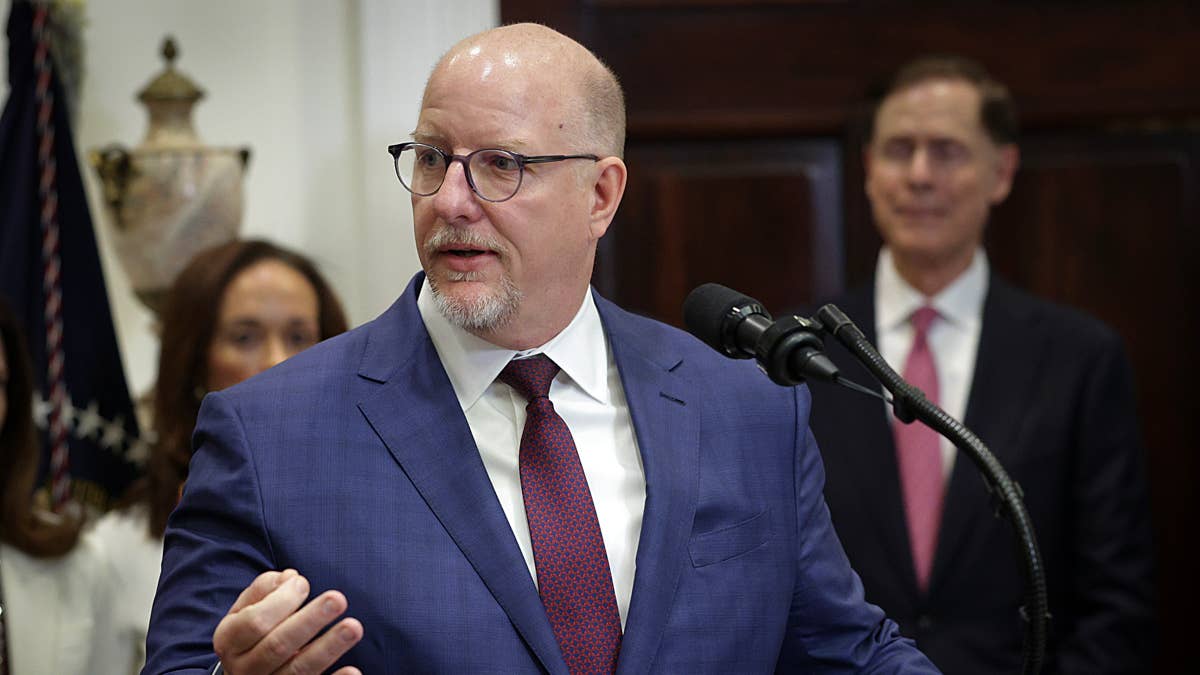
“The potentially practice-changing advances in oncology presented at last weekend’s ESMO [European Society for Medical Oncology] meeting further clinically de-risk the substantial long-term opportunity of our late-phase pipeline,” Merck’s CEO Robert Davis said.
A crucial unknown remains.
Overall-survival statistics aren’t yet available.
According to the experiment, participants survived longer without distant spread or recurrence. It does not yet show that the treatment eventually prolongs life.
One of the most important things that physicians, patients, and investors will be keeping an eye on is that outcome.
Why Merck investors care about one patient’s recurrence
The customized cancer vaccination arrives at a crucial moment for Wall Street.
Keytruda is one of the most effective medications in the world.
But now it is turning into one of Merck’s greatest weaknesses.
Merck’s third-quarter revenues from Keytruda reached $8.6 billion, a 6% increase over the same quarter the previous year.
This indicates that one medication accounted for almost half of Merck’s $18.1 billion in quarterly sales.
But Keytruda’s U.S. patent protections start to expire in 2028, which is an issue.
Lower-cost rivals may ultimately gain market share and drive down costs when popular medications lose their patent protection.
For people who need less expensive medication, that is beneficial.
Losing exclusivity may be unpleasant for the company’s stockholders.
Therefore, before Keytruda’s dominance begins to wane, Merck needs its next generation of medications to grow into significant revenue producers.
This explains why investors responded favorably to Merck’s most recent performance.
The company improved its outlook, exceeded Wall Street’s forecasts for third-quarter sales and profitability, and said that recent trial breakthroughs may lead it to enhance its earlier projection of more than $70 billion in revenue from developing products by the mid-2030s.
According to Reuters, Keytruda sales of $8.6 billion beat analysts’ $7.73 billion estimate, while Winrevair sales nearly doubled to $694 million.
Reuters reported that Merck shares were up more than 4% in midday trading Thursday.
That might seem to be a straightforward revenue response.
The more important question is whether investors are becoming more confident that Merck has a solution to the Keytruda patent cliff.
One possible component of the solution is a customized cancer vaccination.
And unlike some pipeline drugs designed to replace an old blockbuster, intismeran actually uses Keytruda as part of the treatment.
This might enable Merck to create a new product based on the medication it now controls.
Alex Wong / Getty Images
The cancer vaccine has already moved billions on Wall Street
Merck is not the only company whose stock was affected by the new treatment.
Moderna also benefited.
Although the firm gained notoriety for its Covid vaccine, investors have been wondering for years whether its mRNA technology may lead to another significant venture.
Moderna shares more than doubled in a single session after Merck and Moderna revealed in August that the customized melanoma vaccine was successful in the late-stage trial.
The move added about $30 billion to Moderna’s market value, according to Reuters.
That massive response demonstrates what Wall Street thinks may be at risk.
Even if customized mRNA cancer vaccines are limited to melanoma, there may still be significant potential.
The market may grow significantly if the same technology can treat other types of cancer.
Merck and Moderna are already researching the strategy beyond melanoma.
Compared to marketing a single traditional medication to millions of similar individuals, this approach presents a completely different financial opportunity.
The actual course of therapy must be tailored.
A tumor has to be examined.
It is necessary to identify relevant mutations.
Then, a vaccination has to be produced, especially for that patient.
Pharmaceutical production, genetic sequencing, diagnostics, and other segments of the biotechnology supply chain may see increased demand if the strategy gains traction.
However, customization also poses a problem.
It is effortless to produce millions of similar tablets.
Creating a unique cancer vaccine for every patient does not seem likely to be feasible, not with the current state of medical technology.
A patient recuperating from cancer surgery cannot wait forever for a customized therapy; thus, speed is crucial.
Cost will also be important.
If hospitals, insurance companies, or patients cannot realistically obtain a scientifically remarkable treatment, that will restrict its influence.
This situation implies that the commercial test is about much more than the effectiveness of the research.
Merck and Moderna must show that they can manufacture customized cancer treatments consistently, swiftly, and on a scale big enough to become standard medical care.
Merck’s cancer vaccine still has more to prove
In the end, Merck’s stock wager is a wager on preventing cancer.
The Wall Street math doesn’t matter to a patient.
Imagine that medical professionals inform you that the melanoma they removed may return.
Every follow-up scan suddenly carries more weight. A suspicious lymph node matters. A new unexplained symptom can become frightening. If melanoma returns somewhere distant, treatment can become substantially more complicated.
That is why a 42% reduction in the risk of recurrence or death gets attention. It doesn’t mean 42% of patients are cured. It doesn’t mean nobody receiving the vaccine will have their cancer return.
Additionally, it hasn’t shown that patients would live longer.
This indicates that individuals who received the customized vaccination in addition to Keytruda had a significantly reduced probability of recurrence or death throughout the research period compared to those who received Keytruda alone.
That is clinically meaningful. It is also financially meaningful for Merck. Merck’s current value rests heavily on Keytruda. Investors know that clock is running toward the drug’s patent losses.
Wall Street has more reason to think Merck’s profits won’t plummet when Keytruda finally encounters less expensive competition with each successful late-stage medication.
Thus, personalized cancer therapy connects two very distinct types of uncertainty.
A patient with melanoma wants to know whether the cancer will come back.
A stakeholder at Merck wants to know whether the company’s expansion will endure Keytruda’s patent cliff.
In the future, intismeran may be able to answer both questions.
The next benchmarks are important.
The therapy still has to be reviewed by regulators.
Results for overall survival need more time.
Merck and Moderna need to demonstrate that they can produce a customized vaccine fast enough for cancer treatment in the real world.
And whether this development is just a melanoma breakthrough or the start of something much bigger will be determined by studies in other malignancies.
The effect may go well beyond Merck’s stock price if those factors come together.
Cancer patients may get more individualized therapy based on the precise mutations causing their illness.
One of the next big markets for biotechnology might be customized medicine, according to Wall Street.
Additionally, Merck may be able to solve a multibillion-dollar issue by developing a vaccine one patient at a time.
Related: Bank of America has strong message for Merck stock investors