Why Is MiCA Creating A Survival Test For Exchanges?
Europe’s crypto market is approaching a hard regulatory cutoff that could force a large share of exchanges to stop serving clients across the bloc. OKX Europe CEO Erald Ghoos said about 80% of crypto exchanges will not survive the Markets in Crypto-Assets regulation, with unlicensed firms required to stop offering services to EU clients once national transition periods expire on July 1.
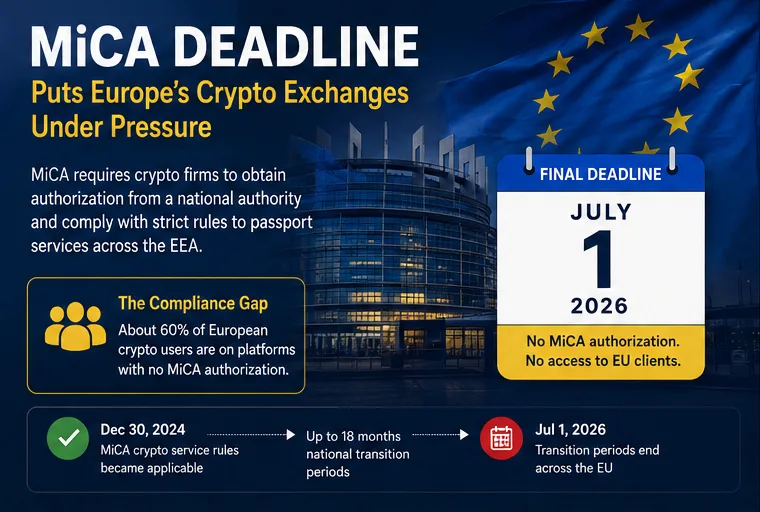
MiCA created one of the world’s first comprehensive crypto asset frameworks, requiring crypto-asset service providers to obtain authorization from a national competent authority in an EU member state. Once licensed, firms can passport services across the wider European Economic Area.
The crypto service provider rules took effect on Dec. 30, 2024, but EU member states were allowed to grant existing firms transitional periods of up to 18 months. That grace period is now closing. Ghoos said 20 of the EU’s 27 member states have already ended their national transition periods, leaving July 1 as the bloc-wide point at which the remaining window closes.
The deadline matters because a large share of users still appear to be trading outside the regulated perimeter. Ghoos said about 60% of European crypto users remain on platforms with no MiCA authorization, and many of those platforms have “no path to getting one.”
What Happens To Platforms Without Authorization?
Unlicensed firms face a narrow set of options once the July 1 cutoff arrives. They can stop serving EU clients, migrate users to a licensed entity, seek a partnership with regulated infrastructure providers, or risk enforcement action. For users, the immediate concern is access to funds, withdrawals, and continuity of service if platforms are abruptly blocked or forced to restrict operations.
“The transitional provisions argument is largely exhausted. 20 of the 27 EU member states have already passed their national transitional deadlines,” Ghoos said. “July 1 closes the window completely. Firms on the ESMA register can continue. Firms not on it cannot. The question is how regulators deal with unlicensed exchanges from that point onwards.”
As of June 18, 2026, more than 200 crypto-asset service providers held full CASP authorization under MiCA, according to the interim ESMA register. Authorized firms must comply with requirements covering transparency, disclosure, governance, supervision, and consumer protection. Stablecoin issuers face reserve rules, while trading platforms must meet obligations around client assets and operational conduct.
OKX secured its MiCA authorization through the Malta Financial Services Authority after holding a virtual asset service provider registration in Malta since November 2021. The approval allows the exchange to passport services across the EEA, including regulated spot trading and stablecoin payments.
Investor Takeaway
MiCA is moving Europe’s crypto market from registration arbitrage to licensed competition. The short-term risk is user disruption on unlicensed platforms. The longer-term impact is likely consolidation around exchanges that can meet capital, governance, custody, and compliance standards.
Why Could MiCA Reshape Market Share?
MiCA gives authorized exchanges a clearer commercial advantage. Licensed platforms can market themselves as regulated venues, passport services across the EEA, and absorb users leaving non-compliant exchanges. That could shift trading volume away from offshore platforms and toward firms that completed authorization before the deadline.
The obligations are not light. A MiCA-licensed exchange must segregate client funds from its own assets, maintain proof of reserves, meet fit-and-proper governance standards, and avoid using client assets for its own account. Client fiat funds received by a crypto-asset service provider must also be placed with an EU credit institution or central bank by the end of the next business day.
Ghoos identified three groups of non-compliant exchanges still active in Europe: offshore platforms with no physical European footprint, exchanges relying on expiring transitional arrangements, and global operators that hold a MiCA license for one subsidiary while still offering an unlicensed global application in European app stores.
That last category may be especially sensitive for regulators because it creates confusion over which entity is serving the user. A global brand may hold authorization in one part of its business while another app or platform remains outside the MiCA perimeter. For investors and retail users, the practical question is whether their account is actually held with a licensed European entity.
What Comes After The July 1 Cutoff?
Europe’s exchange landscape is already consolidating around licensed operators. Major exchanges with confirmed CASP authorizations include Coinbase through Luxembourg’s CSSF and Kraken through Ireland’s central bank. Malta has also become a key jurisdiction for established crypto-native firms, while Germany leads by raw count of authorizations.
Some infrastructure providers are offering alternative compliance routes, including regulated custody and “crypto-as-a-service” models. Ghoos said third-party infrastructure can carry consumer value, but it does not remove a firm’s own obligations around capitalization, governance, and anti-money laundering compliance.
“MiCA was designed to establish a baseline for operating responsibly in Europe: segregated assets, proof of reserves, fit-and-proper governance, operational resilience,” Ghoos said. “The bar was set high because the cost of getting it wrong falls on ordinary people. The fact that a large proportion of the market can’t clear it is the mechanism working.”
He added: “What emerges on the other side is smaller but more structurally sound. The exchanges left standing will have done so because they treated authorization as the foundation for building a serious financial institution, not as a deadline to chase.”
For investors, the July 1 deadline is not only a compliance date. It is a market structure event. The firms that remain authorized will likely gain user flows, institutional credibility, and stronger regulatory footing, while platforms outside the framework face pressure to exit, restructure, or lose access to one of the world’s most important regulated crypto markets.