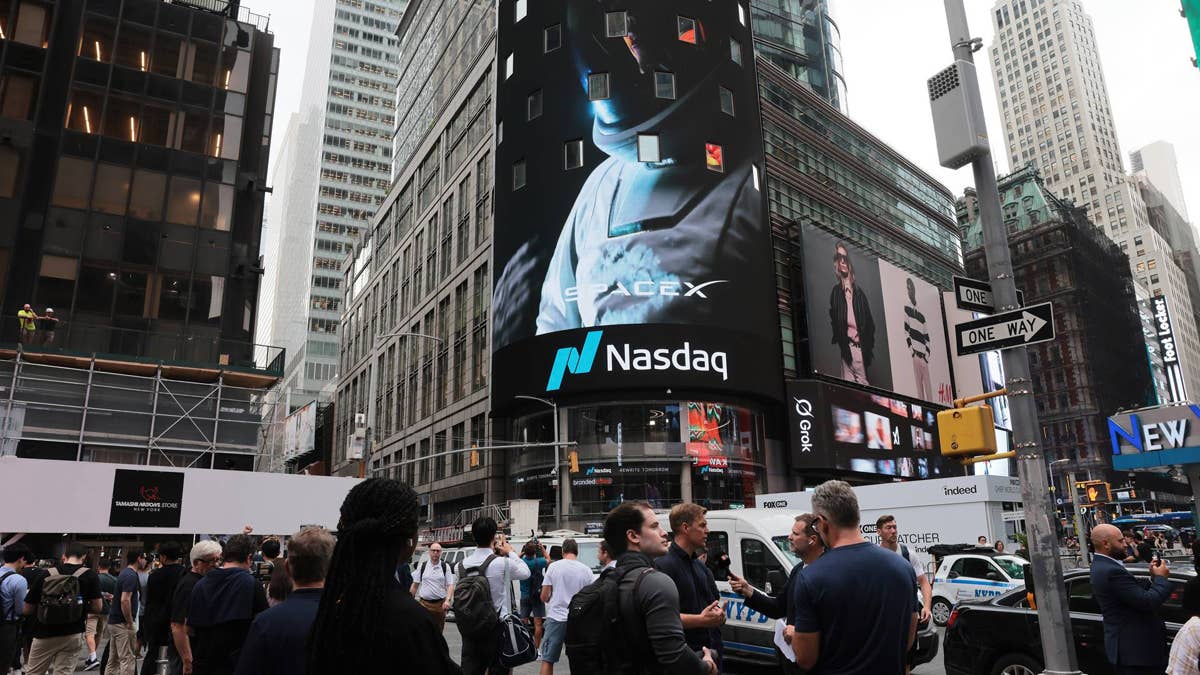
SpaceX closed its first session on the Nasdaq at $160.95, a 19% gain that pushed the company’s market capitalization past $2 trillion, according to Reuters.
The June 12 listing raised $75 billion in the largest initial public offering in history, with demand exceeding available shares by a factor of four.
But one prominent Wall Street strategist argues that the most consequential financial events for SpaceX shareholders are still weeks away.
He is pointing investors toward a series of index inclusion dates that will force funds managing trillions of dollars to buy SpaceX shares this summer.
SpaceX could enter Nasdaq 100 as early as July 6
Peter Haynes, head of index and market structure research at TD Securities, told CNBC the public debut was just one piece of a longer timeline.
Haynes identified one date in particular as the first major inflection point following the June 12 listing under the ticker SPCX.
“Day 15, which should be July 6, will be the day that Nasdaq rebalances the 100 Index to reflect SpaceX’s IPO shares,” Haynes told CNBC’s “ETF Edge” ahead of the listing.
That timeline is possible because Nasdaq revised its index methodology on May 1, 2026, creating a faster pathway for the largest new listings.
Under the revised rules, any company ranked in the top 40 by market capitalization can enter the Nasdaq-100 after just 15 trading days, etf.com reported.
We think the company has been significantly overvalued and investors will have opportunities to buy the stock at more attractive levels after the IPO.
Nasdaq also eliminated the prior 10% minimum free-float requirement and now applies a 3x multiplier to the float-adjusted market cap of any qualifying company with public float below roughly 33%, capped at the company’s total market capitalization.
For SpaceX, with a public float of only 3% to 4%, the multiplier materially increases its index weighting.
With a first-day market cap above $2 trillion, SpaceX clears that eligibility bar by a wide margin, and no profitability test applies under Nasdaq’s framework.
Total assets tracking the Nasdaq-100 exceed $1.4 trillion, according to CME Group, including roughly $500 billion in the Invesco QQQ Trust, etf.com reported.
S&P 500 inclusion will not happen before mid-2027 at the earliest
The Nasdaq’s accelerated pathway stands in sharp contrast to a decision revealed by S&P Dow Jones Indices on June 4.
S&P confirmed it would maintain existing eligibility rules for the benchmark index, including a mandatory 12-month seasoning period for all newly listed companies.
The rules also require positive earnings under Generally Accepted Accounting Principles in the most recent quarter and cumulatively over the trailing four quarters, CNBC reported.
SpaceX posted a net loss of $4.94 billion against $18.67 billion in revenue for 2025, the company’s S-1 filing with the Securities and Exchange Commission disclosed.
Revenue grew 33% year over year, but the profitability requirement pushes the earliest plausible window for S&P 500 eligibility to mid-2027.
Haynes described the decision as “controversial” and argued that excluding a company of SpaceX’s scale weakens the benchmark’s representativeness of the broader equity market.
Spencer Platt/Getty Images
Analysts project $22 billion to $30 billion in forced passive buying this summer
Each index inclusion event triggers mandatory purchases by every fund tracking that specific benchmark, and the combined scale of those capital flows is substantial.
BNP Paribas estimated that the Nasdaq-100 addition alone would generate approximately $8 billion in passive buying during SpaceX’s first month of trading, Investing.com reported.
Total passive inflows across all near-term index events could reach roughly $30 billion, the firm’s cash equities team projected.
More SpaceX:
- Elon Musk sets SpaceX IPO price in blunt message to Wall Street
- Veteran hedge fund manager makes a brazen SpaceX bet
- Franklin Templeton CEO sends strong message on SpaceX
SpotGamma, which models institutional fund mechanics, offered a narrower estimate of $22 to $27 billion in forced buying concentrated across Nasdaq-100 and Russell index-tracking funds.
Todd Sohn, chief exchange-traded fund strategist at Strategas Securities, summarized the implications for investors choosing between broad index products on CNBC.
“If you want SpaceX, you’re not buying the S&P 500,” Sohn said. “You’re going to buy the Nasdaq 100 or the Russell 1000.”
SpaceX’s narrow float could magnify every index-driven purchase
The buying pressure from index rebalancing becomes more consequential when the number of SpaceX shares available for open-market trading is factored in.
The company’s public float represents only 3% to 4% of total outstanding shares, according to the S-1 prospectus filed with the SEC.
Founder shares carry a 366-day lockup, and other major institutional holders face restrictions that lift only in stages through the end of 2026.
Bloomberg Intelligence estimated that S&P 500 funds would eventually need to absorb 19% of SpaceX’s public float upon inclusion, with the Nasdaq-100 and Russell 1000 funds accounting for another 24%, CME Group reported.
Passive funds do not negotiate on price or delay purchases in search of more favorable entry points; they buy whatever the index methodology requires at market price on rebalance day.
That purchasing, concentrated into narrow windows against a limited pool of tradable stock, is the structural dynamic sitting at the center of Haynes’ argument.
The combination of accelerated Nasdaq inclusion, a delayed S&P 500 timeline, and a single-digit public float concentrates the next phase of SpaceX price discovery into a series of mandatory passive-fund purchases scheduled between July 6 and the end of 2026.
Related: SpaceX president reveals what investors should be watching