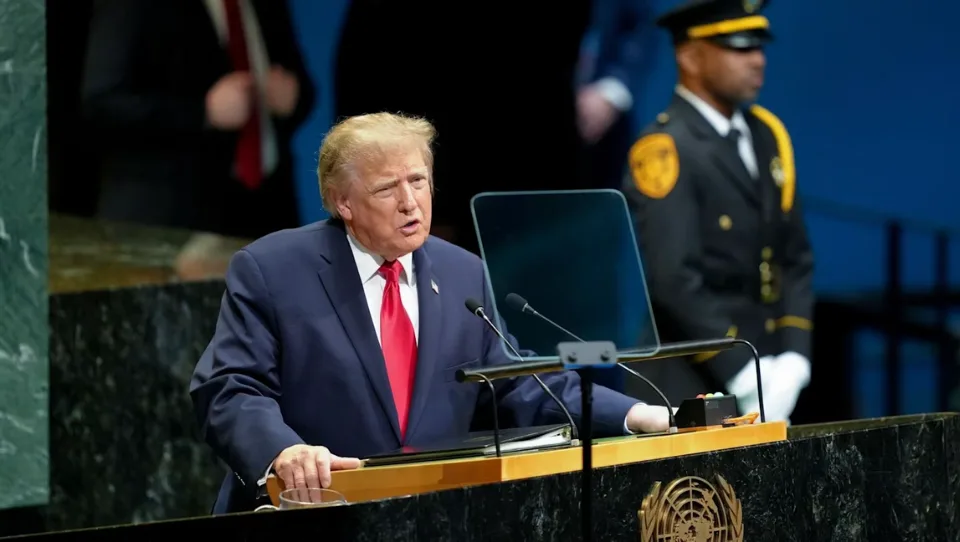
The crude oil price got the one thing it has chased all year on Tuesday, a rough date for the end of the Iran war, and it was not the date traders wanted. In his address to the United Nations General Assembly, President Donald Trump said he faces a “big decision” between a negotiated deal and choosing to “annihilate the Islamic Republic,” and told the assembly, “I believe we’ll make a deal right after the election because it doesn’t make sense for them not to,” as reported by CNBC from his UN speech.
He then revealed his team had just finished a three-hour meeting with Iran’s representatives. That put a stated expiry on the war-risk premium, roughly six weeks out, with no guarantee the barrels start moving before then.
The crude oil price spent the session see-sawing on the headlines. Brent settled at $99.25 a barrel on Tuesday, down 1%, and WTI settled at $94.59, down 1.2%, according to CNBC, a fifth straight loss that leaves oil down more than 4% on the week but still up about 9% on the month. By Wednesday the Brent crude oil price had bounced back above $100 to around $101.63, per OilPrice.com, a reminder that a market pricing a six-week wait reprices on every sentence out of New York.
The Brent crude oil price ran to about $109 on September 15 before fading, then rebounded above $100 on Wednesday. Source: OilPrice.com.Trump Accused Iran of Stalling for the Midterms
Trump’s framing was blunt, and the specific words matter for how the crude oil price moved. Alongside the “annihilate the Islamic Republic” line, he added the part the market fixed on: “They’re waiting to see how I do in the midterm election. What they don’t realize is that I’m not running.” The threat of force and the promise of a post-election deal arrived in the same breath, which is why traders spent the session trying to weigh one against the other.
Trump said Iran is stalling, deliberately holding off on reopening the Strait of Hormuz and settling the war until after the vote, in the belief that higher pump prices will hurt his party. That reframes the delay as a negotiating tactic rather than a diplomatic breakdown, which is why the market read his speech as confirmation that no deal arrives before November 3. Prices jumped while he was speaking, then faded after he disclosed the three-hour meeting, which he called “very good.”
The Saudi Pipeline and Hormuz Are the Physical Lever
The reason the timeline matters so much for the crude oil price is that the supply crunch behind it is real and ongoing. Iran has kept the Strait of Hormuz effectively closed since February, choking a waterway that carried roughly a fifth of the world’s oil before the war, and traffic now runs at a fraction of pre-crisis levels. The second lever is Saudi Arabia’s East-West pipeline, the 1,200-kilometer line that lets the kingdom bypass Hormuz and ship crude from the Red Sea. Drone strikes from Iraqi territory forced it shut on September 10-11, removing what had become Saudi Arabia’s main export route, as Al Jazeera reported.
Both levers are now in partial motion, which is what has capped the oil price even with a deal weeks away. Saudi Aramco has begun restarting the pipeline at a reduced rate after the tanker-and-mines standoff in Hormuz, and Iran has floated reopening the strait within seven days if Washington lifts its naval blockade. Both moves are conditional, and both ask the other side to act first, which is exactly the standoff Trump’s post-midterm timeline leaves unresolved.
Investor Takeaway
The premium now has a stated expiry, not a guarantee, since Trump put the deal after the November midterms, so the war-risk in the crude oil price is priced to a date the physical supply may not honor.
Prediction Markets Price Hormuz Reopening at 21% by Year-End
The betting markets put numbers on the wait, and they agree the resolution comes later rather than sooner. On Polymarket, the market on the Strait of Hormuz returning to normal by December 31 prices only a 21% chance, on more than $12.5 million of volume, with the odds falling to 13% by November and just 1% by the end of September. Traders see the blockade lifting sooner than the strait fully reopening: the market on the US announcing an end to the Iranian blockade rises from 8% by September 30 to 34% by October and 62% by December, on more than $31 million of volume.
The tail risk stays contained. The market on whether the US invades Iran before 2027 sits at 15%, on more than $68 million of volume, and one trader noted the invasion odds “never left the teens” through a summer of strikes. Read together, the money lines up with Trump’s own framing: a negotiated de-escalation that firms up after the midterms, not a sudden breakthrough and not a ground war.
What Breaks the Post-Midterm Timeline for the Crude Oil Price
The timeline is a belief, not a schedule, and several things could snap it in either direction. A failed round of diplomacy at the UN, a fresh strike on Gulf infrastructure, or a stalled pipeline restart would put the war premium straight back into the crude oil price. A verified de-escalation, Hormuz transits actually recovering, Yanbu exports running at full rate, or a US move to ease the blockade, would pull it out faster than November.
The political stakes are why the six weeks matter beyond the barrel. US retail gasoline hit about $4.47 a gallon on Tuesday and diesel a record $6.52, both up sharply since the war began, as NBC News reported, and those pump prices are the mechanism by which the Iran war reaches voters. Trump has told the market to wait until after the election. Whether the crude oil price waits with him depends on whether the physical supply, not the political calendar, cooperates first.
Investor Takeaway
The prediction markets agree the resolution comes late, with Hormuz normalization priced at just 21% by year-end and the blockade more likely to lift than the strait to reopen, which matches Trump’s after-the-midterms framing.