Bank of America economists updated their interest-rate forecast and it ain’t pretty.
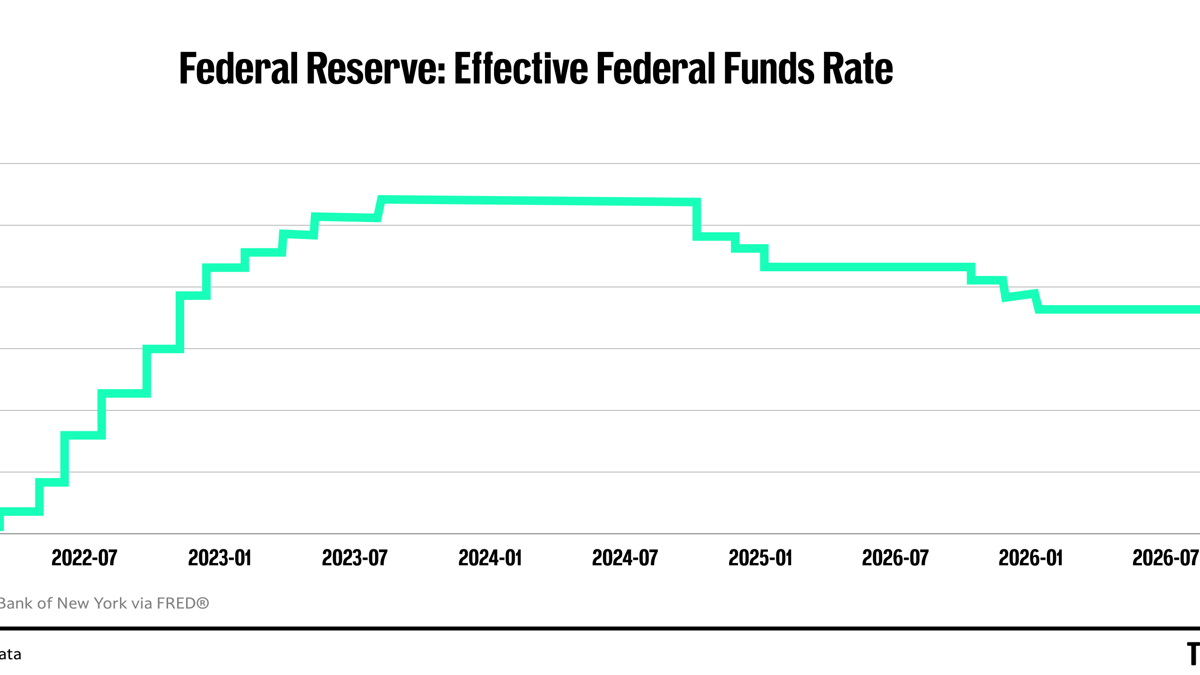
Economists at BofA Global Research now expect the Federal Reserve to hike short-term interest rates at the next three meetings — plus forecast the potential for the benchmark federal funds rate to increase as much as 5% due to persistent inflation.
Those fast-and-furious rate hikes will cause big problems for Americans’ credit-card bills, business and student loans, and, indirectly, mortgage rates.
In a Nov. 13 note obtained by TheStreet, BofA Global Research economist Aditya Bhave said the expected 25-basis-point hikes in December, January and March are in response to the hotter-than-expected October CPI report and its forecast of a dire October PCE on Nov. 25 — the Fed’s preferred inflation gauge.
“Inflation momentum is moving in the wrong direction, owing in part to AI and consumer demand,’’ Bhave said in the note.
But that’s not all: “A surge in wage inflation or large annual price resets could push the policy rate above 5%.
For consumers, investors and businesses, BofA’s warning that interest rates could climb above 5% is an increasingly important risk to watch from the sidelines.
BofA warns of potential Fed rate hikes hitting 5% level
The policymaking Federal Open Market Committee voted 10-2 in its October meeting to pause the benchmark federal funds rate at the target range of 3.75% to 4%. BofA estimates the funds rate will hit 4.5% to 4.75% after the March 16-17 meeting.
Why the extra 25 basis-point hike in January?
“After (October) CPI, the Fed looks further behind the curve on inflation. It no longer has the luxury of hiking at a quarterly pace,’’ Bhave said, adding that risks to the new call were balanced.
“The Fed might delay or skip the last hike if there’s a soſt patch in the data or significant tightening in financial conditions,’’ Bhave said.
Cleveland Fed President Beth Hammack, one of the two October FOMC dissenting voters, once again voiced hawkish support for smaller, incremental Fed rate hikes to bring inflation back down to its 2% target — a goal it has missed for nearly six years.
“I think the more predictable we can be, the better it is for businesses and households to be able to plan and to think about their finances,” she told Bloomberg Television Nov. 16. “If we get behind the curve and we need to put more restriction in, we absolutely can move in those larger increments.”
TheStreet
BofA targets hot inflation for increase in Fed rate hikes
CPI inflation topped expectations for a third consecutive month in October, with headline and core prices rising 0.4% and 0.3% month-over-month, respectively. Those price gains were broad-based. There wasn’t an annual inflation rate because of last year’s government shutdown.
“We revised our core PCE tracking estimate from 0.23% to 0.32%’’ month-over-month and 3.3% year-over-year aſter incorporating the CPI data,’’ the note said.
As I reported, the FOMC voted in September to raise rates by 25 basis points, the first hike in three years.
A faster pace of tightening could be just around the bend.
The CME Group’s FedWatch Tool projects roughly a 100% probability of a rate hike at the FOMC’s December meeting, a 72.5% probability of another in January 2027, and roughly a 92.4% probability of a third consecutive increase in March 2027.
Related: Fed rate hikes could stretch into 2027 as darker threats loom
Fed Governor Christopher Waller startled Main Street and Wall Street when he said, as I reported, a 50-basis-point rate hike should be considered at the December policymaking meeting if inflation continues to run hot.
In addition to BofA, Citi and Standard Chartered have acknowledged a stronger case for the half-point increase but say the evidence is not yet sufficient to make it their base case.
FOMC October meeting notes to show “deeper divide” on pause: BofA
BofA’s latest note also indicated that the notes of the October meeting to be released on Nov. 18 will show the FOMC had a “deeper divide over the decision to be on hold than the 10-2 vote suggested.”
Really?
Hence:
- Those favoring a hold likely argued the rise in yields was doing some of the Fed’s work and pointed to financial market concerns.
- Those opposed likely emphasized the economy’s underlying strength and the risk of falling behind the curve.
“The subsequent data flow should reinforce the latter camp’s concerns, and lead them to push for picking up the pace of hikes going forward,’’ the note said.
New Fed survey shows CEO inflation expectations on the rise
Inflation expectations among U.S. business leaders increased in the fourth quarter of 2026, according to the Cleveland Fed’s Center for Inflation Research in a quarterly survey released Nov. 16.
CEOs and other top executives reported in October that they expect the CPI to increase by 3.5% over the next 12 months, up from their previous forecast of 3.3% in July.
The Cleveland Fed reports this data because business leaders’ inflation expectations can influence the prices their firms charge customers, and thereby affect the path of inflation.
Over the next five years, they expect CPI inflation to average about 3.3% annually.
The Cleveland Fed’s findings add another complication to the inflation outlook: When business leaders expect prices to keep rising, they may be more inclined to raise their own prices, thus making the Fed’s goal of restoring its 2% inflation target even harder.
Related: Jumbo Fed rate-hike warning sends shock waves after inflation surprise
.