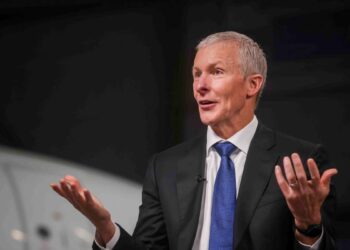
Most tech executives selling the AI revolution focus on what it will do for everyone. Better products, more efficiency, higher productivity, broadly shared prosperity. It’s the pitch that keeps the investment flowing and the public sentiment warm. Alex Karp isn’t making that pitch.
The Palantir CEO, who is already worth around $15 billion, thanks in large part to what AI has done to his company’s valuation, sat down on the MDMeets podcast with Axel Springer CEO Mathias Döpfner and said something most CEOs in his position wouldn’t say out loud.
What Alex Karp said about AI wealth inequality and the middle class
“The biggest problem in this country is AI will raise the standard of living of the average person, but the people involved are likely to get 10, 100 times wealthier than they already are,” Karp said on the podcast. “That’s a problem for society,” according to Fortune.
He estimated AI could make him “20x wealthier,” which would put his fortune somewhere approaching $300 billion. Middle-class workers, he said, might just see their salaries double over the next decade. He called the gap a “complete decoupling of unimaginable wealth and normal wealth.”
He also had something to say about the people who stand to get the richest. “It’s done by people you don’t really relate to, like very oddly shaped IQ specimens that you probably wouldn’t want to have over for dinner,” he said. “And if they were over for dinner, you’d have nothing to talk to them about, and vice versa.”
And then: “The overselling of AI in this country is really somewhat disconcerting, but it’s also depressing because you don’t have to do it.”
A billionaire CEO warning about AI wealth concentration is worth taking seriously
Karp isn’t a skeptic on AI. He’s one of its biggest winners. Palantir’s market cap sits at roughly $322 billion. His own net worth got to $15 billion because investors believe in what the company is building.
When he says the wealth gap created by AI is a societal problem, he’s saying it as someone who is actively making the gap wider.
Related: Meta, Anthropic drop bombshell news on AI market
That’s what makes the comments unusual. He’s not describing a future he might be excluded from. He’s describing one where he ends up with $300 billion, while average workers get a salary that doubled over a decade. And he’s calling it a problem while still planning to collect the $300 billion.
The data back up his concern. Global billionaire wealth surged more than 16% in 2025, three times faster than the previous five-year average, reaching $18.3 trillion, its highest level ever, according to Oxfam.Elon Musk‘s fortune currently stands at around $833 billion after he briefly became the world’s first trillionaire earlier this year.
Larry Fink, Jamie Dimon, Geoffrey Hinton on AI wealth inequality and workers left behind
Karp isn’t alone in saying this out loud. BlackRock CEO Larry Fink made a similar point at the World Economic Forum in Davos. “Early gains are flowing to the owners of models, owners of data and owners of infrastructure,” Fink said.
“The open question: What happens to everyone else if AI does to white-collar workers what globalization did to blue-collar workers?”
Geoffrey Hinton, the Nobel Prize-winning computer scientist often called the Godfather of AI, was more blunt. “What’s actually going to happen is rich people are going to use AI to replace workers. It’s going to create massive unemployment and a huge rise in profits. It will make a few people much richer and most people poorer. That’s not AI’s fault. That is the capitalist system.”
Jamie Dimon has been more measured but still acknowledged the frustration is real. “If you were the average citizen here and you say, ‘These wealthy people are getting unbelievably wealthy, and this segment’s been left behind,’ that’s kind of annoying,” Dimon told Axios. “We have, in fact, left the lower-income folks behind.”
David/Getty Images
What the AI wealth gap looks like in practice for American workers
Karp put two numbers on the table. His net worth could go from $15 billion to $300 billion. A middle-class worker’s salary might go from $70,000 to $140,000.
Both double, yet one of those outcomes funds private islands, while the other pays off a mortgage. That’s the decoupling he’s talking about, and he’s one of the people on the better side of it.
History suggests the concern is grounded. Technological revolutions have historically taken a long time to distribute their gains broadly. The productivity gains from computers in the 1990s took nearly a decade to show up in wage growth. AI may be faster, but the ownership structure around it is more concentrated than almost any previous technological wave.
The companies capturing the most value from AI, Palantir, Nvidia, Microsoft, Google, are owned primarily by shareholders and executives with large equity stakes.
Workers may benefit through automation that makes their jobs easier or through higher wages in technical roles. But the financial upside of owning the platforms is in a different category than the income upside of working on them.
5 ways AI wealth inequality could reshape workers, wages, and markets:
- Tax policy pressure: Oxfam estimates that a 10% wealth tax on a $1 trillion fortune would raise roughly $100 billion, enough to lift more than 800 million people out of extreme poverty for a year. As AI fortunes grow, pressure for wealth taxes on the biggest winners is likely to intensify.
- Labor market polarization: Karp has said AI favors workers with practical and vocational skills over people in office-based or humanities-heavy careers. Welders and electricians are harder to automate than paralegals and junior analysts. That divide is already showing up in wage data and it’s likely to get more pronounced.
- Regulatory scrutiny: Politicians follow public anger. If enough people start seeing AI as a machine that makes billionaires richer while their own wages crawl, the regulatory response won’t be subtle. Competition rules, data ownership laws, and labor protections become harder to resist when the wealth gap is this visible and this large.
- Investor sentiment risk: A sustained public backlash against AI wealth concentration could create headwinds for companies seen as the primary beneficiaries. Palantir itself has already faced criticism for its government surveillance work. Broader wealth inequality concerns add another layer of reputational exposure.
- Corporate response: BlackRock’s Larry Fink backed up his Davos speech with $100 million in funding for skilled trade worker training earlier this year. More companies may face pressure to demonstrate that they’re investing in workforce development as AI scales.
Karp’s honesty about where the AI money is going is unusual and worth taking seriously.
He’s not predicting disaster. He’s saying the system produces unequal outcomes by design, the people at the top know it, and most of them just aren’t saying it as directly as he is.
Related: Nvidia CEO doubles down on AI and stock market verdict