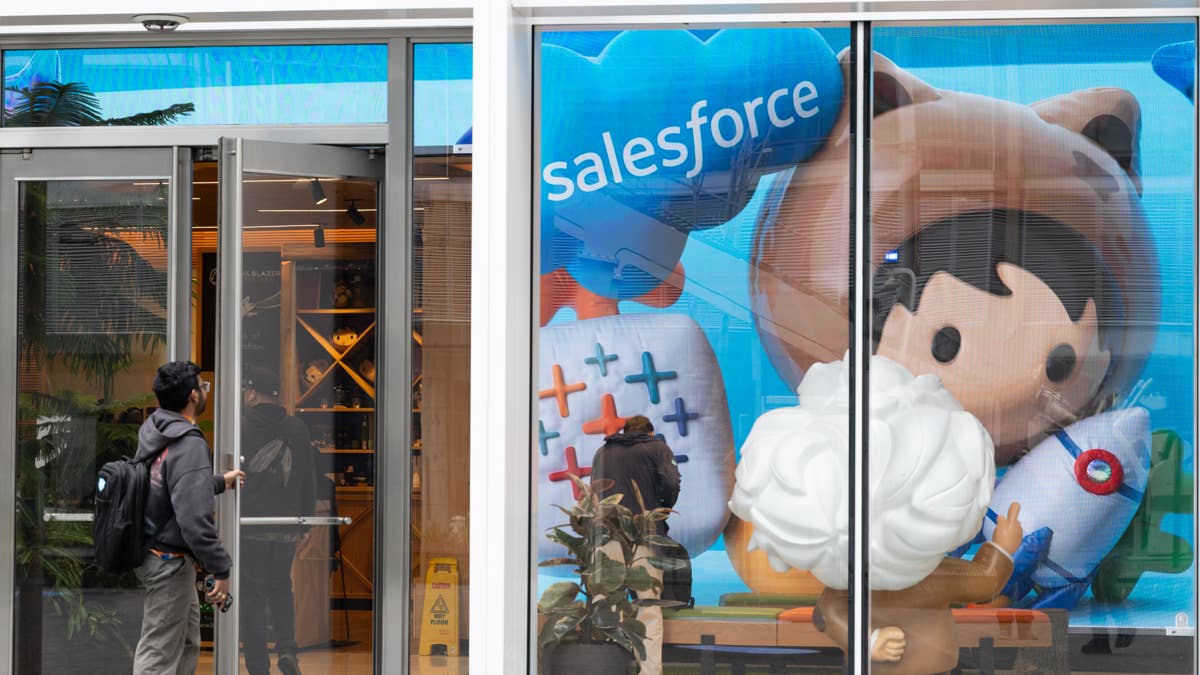
Salesforce (CRM) shares jumped more than 22% this week after a blockbuster earnings report and a splashy new AI partnership.
Two days later, Morgan Stanley raised its price target on the stock by 27%, yet kept the same cautious rating it has held for years. That gap, between a euphoric market and a skeptical analyst, is the real story.
The Salesforce rally hid the number that mattered most
This week’s excitement traces back to just one figure. Salesforce reported a $2.6 billion gain tied to its stake in AI company Anthropic, which helped drive net income up 87% year over year, according to CNBC.
That is a paper gain from an investment, not a new revenue from selling software.
Related: Morgan Stanley reveals Cisco’s quiet edge over rivals
Salesforce is not alone in booking that kind of windfall. Microsoft and Alphabet have each recently disclosed similar paper gains from their own stakes in Anthropic, CNBC reported, a reminder that some of this earnings season’s flashiest profit jumps are coming from balance sheets rather than customer demand or sales.
On the same day, Salesforce and Anthropic unveiled Claudeforce, an expanded partnership that lets sellers manage deals directly inside Anthropic’s Claude assistant, according to a press release.
That announcement, paired with the investment gain, is likely what pushed the stock up 22.6% on Thursday, Aug. 27, according to The Motley Fool.
Morgan Stanley’s own note, released hours later, focused on a smaller and less flashy number. The quarter’s actual revenue beat over Wall Street consensus came to only about $20 million, the firm noted, meaning the underlying business grew roughly in line with expectations.
ALSO READ: What does Salesforce do? Who uses it & how it changed everything
Salesforce bookings growth is what convinced Morgan Stanley
Salesforce’s solid growth led Morgan Stanley analysts, led by Adam Wood, to look past the headline print toward current remaining performance obligations (cRPO), a measure of contracted revenue not yet delivered.
The metric grew 14% in constant currency, about a percentage point above Salesforce’s own guidance, according to the Morgan Stanley note shared with TheStreet. It was the first meaningful upside on that measure in two quarters, a sign that demand is building rather than fading.
Salesforce’s outlook for the current quarter matters just as much. Management guided to roughly 14% constant-currency cRPO growth for the third quarter, ahead of the Street’s expectation near 13%.
Morgan Stanley called that guidance a genuine sign of reacceleration rather than a one-quarter fluke, since it excludes any contribution from two pending acquisitions.
Benjamin Fanjoy / Getty Images
Retention data undercuts the AI disruption fear
For more than a year, investors have worried that AI-native rivals would let companies build their own customer relationship tools and walk away from per-seat software like Salesforce.
The quarter’s retention numbers argue otherwise. Customer attrition stayed near record lows, and contract lengths grew longer across every major product line, according to the Morgan Stanley note.
Net new average order value, a measure of how much new customers commit to spending upfront, hit its highest level in four years. That is important because it reflects fresh buying decisions, not renewals of contracts signed before AI became a boardroom worry.
More Morgan Stanley:
- Morgan Stanley reveals Cisco’s quiet edge over rivals
- Morgan Stanley sees big change coming for Alphabet stock
- Morgan Stanley sends clear signal on stock market, oil prices
Agentforce, Salesforce’s flagship AI agent product, also showed accelerating adoption. Annualized revenue from the product topped $1.5 billion and grew more than 240% year over year, up from roughly 205% growth the prior quarter, Morgan Stanley found. Bookings for its premium tier more than doubled from the first quarter.
Even so, Morgan Stanley’s own math shows how wide the range of outcomes remains. The firm’s scenario analysis spans from deep skepticism to real conviction.
- A bear case of $90, built on AI-native competitors eroding growth toward the mid-single digits over three years.
- A base case of $235, the firm’s actual target, assuming double-digit revenue growth helped along by recent acquisitions.
- A bull case of $350, which requires roughly 15% annual revenue growth through 2029 on rapid Agentforce adoption.
A higher target, the same cautious rating
Despite the target increase, Morgan Stanley kept its Equal-weight rating, a call the firm has held on Salesforce since 2021. The reason: organic subscription revenue growth, stripped of currency effects and acquisitions, actually slowed to about 6% in the quarter from about 7% in the prior one.
Legacy units are still a drag. Salesforce’s Commerce and Tableau businesses continue to face license-revenue headwinds and unpredictable bookings, the firm said, and it is not yet clear when that softness resolves.
At roughly 28 times projected 2027 earnings, Morgan Stanley considers the stock fairly valued rather than cheap.
Morgan Stanley’s caution puts it in the minority. Nearly three-quarters of analysts covering Salesforce rate it Overweight or the equivalent, well ahead of the roughly one-fifth who share Morgan Stanley’s more neutral view.
The bigger test here is not really about Salesforce at all. It is whether a generation of decades-old enterprise software companies can bolt AI agents onto platforms built for a different era and reignite growth, instead of being replaced by leaner AI-native rivals.
The next few quarters of booking data, not the size of any single investment gain, will decide which story is true.
Related: Morgan Stanley sees big change coming for Alphabet stock