D-Wave is not a $35 stock here just because an average target still sits near that level. QBTS closed at $10.37 on Tuesday 3 November 2026. The 40-session path through 31 December 2026 is a bull case of $11.84, a base of $7.31, and a bear case of $5.30. The bull is $1.47, or 14.18 percent, above that close. The base is 29.51 percent below it, and the bear is 48.89 percent below it.
The useful fact is the August call, not the Street sheet. John Markovich, then chief financial officer, said third-quarter revenue was likely up only modestly from second-quarter revenue of $3.1 million, because both annealing systems expected this year were likely to ship in the fourth quarter. Results for the quarter ended 30 September 2026 are scheduled for 10 November 2026, before the open, and the print is not out. MarketBeat’s 3 November page still shows a $4.37 million estimate and a $35.40 average target, a different exercise from the $11.84 bull.
Key facts
- QBTS closed at $10.37 on 3 November 2026, up $0.28, or 2.78 percent, from $10.09, in the Nasdaq historical file.
- The 40-session bull is $11.84, the base is $7.31, and the bear is $5.30. A bull within $1 of $35, $37, or $37.56 would have been discarded.
- The 27 October 2026 release sets the third-quarter print for Tuesday 10 November 2026, before the open. The print is not out.
- Markovich said second-quarter revenue was $3.1 million and cash was $546.2 million at 30 June 2026, down 33 percent from $819.3 million.
- First-half bookings were $35.5 million, including a $20 million Florida Atlantic system, and backlog was $40.7 million.
- The 4 September 2026 CHIPS award is up to $100,000,000. The 8-K says the company will issue 7,095,721 shares at $14.093.
- MarketBeat on 3 November forecasts a $0.1008 loss and $4.37 million of revenue, with a $35.40 average target. B. Riley’s target there is $27.
- The 20-day average is $12.26225 and the 50-day average is $15.0737. The close is 15.43 percent and 31.20 percent under those marks.
What just happened, and why the obvious reading is wrong
The close rose from $10.09 to $10.37, with an open of $10.16, a high of $10.505, and a low of $10.1324. Volume was 8,530,816 shares, against 11,584,000 on Monday. Monday’s low of $10.02 is the 2026 low in this file and the low end of the Nasdaq range label, 10.02 to 37.62. That label is not a pair of closes.
The 2026 high close is $31.27 on 6 January, with a high of $31.38. From the 31 December 2025 close of $26.15, Tuesday is down 60.34 percent. From 6 January, it is down 66.84 percent. A pre-market sale of $10.68 at 6:03 a.m. Eastern on 4 November is not the spot. The info endpoint still showed $10.37 closed at 4:00 p.m. on 3 November, and the exchange as NASDAQ-GS. FinanceFeeds covered the Nasdaq transfer as a holder event, not as this path. Any later bar is ignored.
On the MarketBeat page dated 3 November 2026, $27 is 160.37 percent above $10.37 and $35.40 is 241.37 percent above it. This title uses 90 daily log returns instead, from the 26 June close through 3 November. The file has 359 closes. Mean mu is -0.008734306522407715. Sample sigma, from statistics.stdev, is 0.05084303944100527. N is 40 because Tuesday is in the file. The count skips only 26 November and 25 December. Early closes on 27 November and 24 December still count.
Base is 10.37 times e to the power of N times mu, or 7.31220, which rounds half up to $7.31. Bull adds 1.5 times sigma times the square root of 40, and that root is 6.324555320336759. The unrounded bull is 11.84474, or $11.84. Bear subtracts one sigma times that root. The unrounded bear is 5.30148, or $5.30. A no-drift bull of $16.80 is not used, because the bull with drift already clears the spot. Ten sessions ending 17 November are $12.09, $9.50, and $8.09. Fifteen ending 24 November are $12.22, $9.10, and $7.47. Twenty ending 2 December are $12.25, $8.71, and $6.94. None collides with a banned pair, so the year-end path stays.
The 27 July session stays in the sample. The close went from $16.21 to $19.51, a log return of 0.18529881888743507 and a gain of 20.36 percent. Dropping it only as an illustration would cut sigma to 0.04670925912193081. A calmer sigma would have drawn a tighter band than the tape earned.
Who is exposed
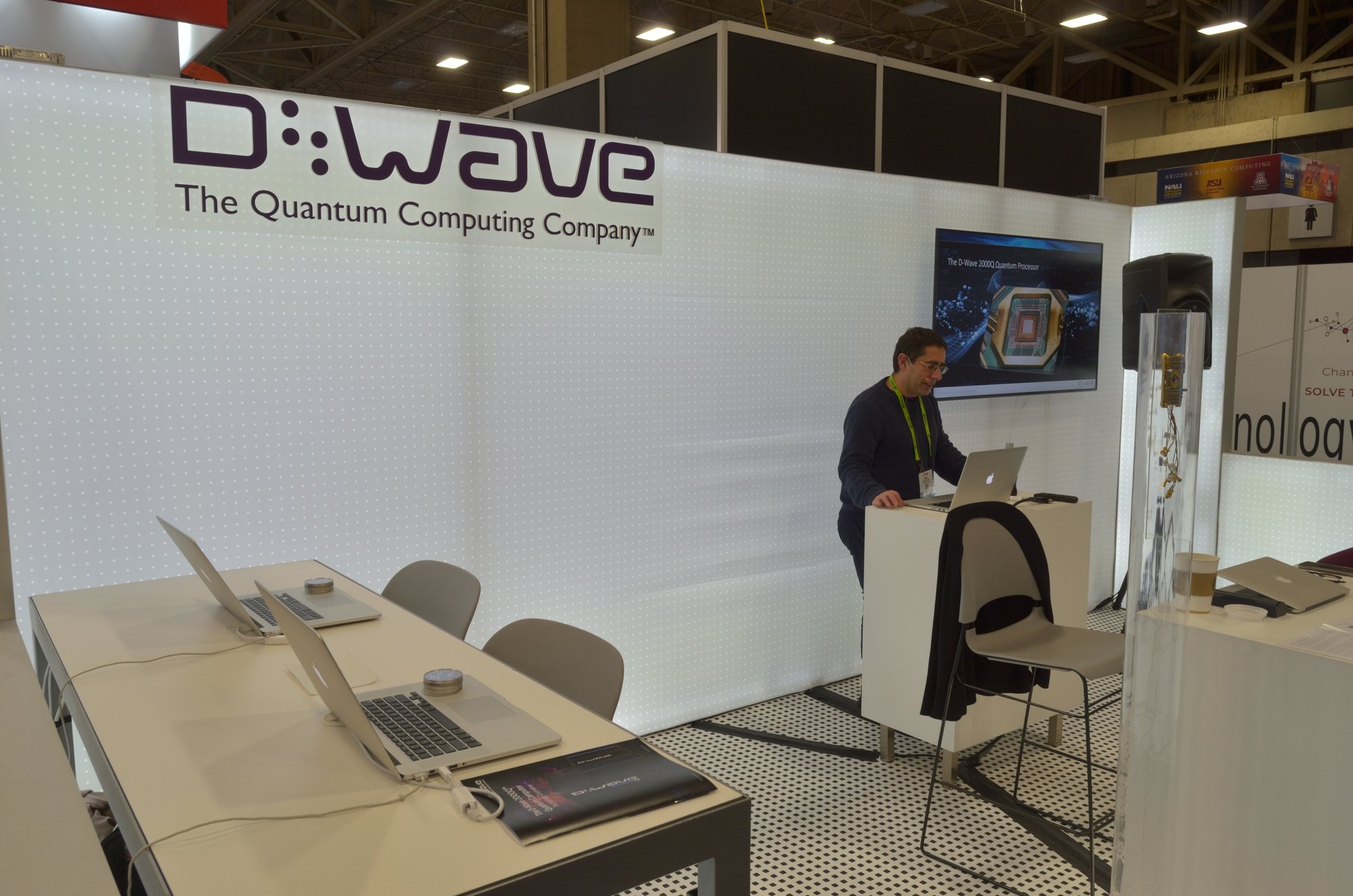
The stock is D-Wave Quantum Inc. common stock, QBTS, on NASDAQ-GS. The info payload had no share count and no market cap, so neither is invented. The 8-K address is 2650 East Bayshore Road, Palo Alto. The photograph is an SC18 booth with the D-Wave name readable. It is not that office.
Markovich said the second quarter had about 100 customers, with 62.4 percent of revenue from commercial enterprises against 45.1 percent a year earlier, and Forbes Global 2000 customers at 47.7 percent against 20.4 percent. In the first half, commercial customers were 67.7 percent of revenue against 16 percent. He corrected the Forbes share of first-half revenue from 48.8 percent to 48.5 percent, against 7.5 percent.
The $20 million Florida Atlantic system contributed about $300,000 of second-quarter installation revenue, not the system price. Baratz still expected delivery in 2026 and two to three system deals a year, including two deliveries in 2026. He said one AT&T application cut processing time from about an hour to under 15 seconds. Optum, a UnitedHealth Group subsidiary, had run about 30,000 jobs by mid-June after a May launch. NTT DOCOMO cut paging signals 15 percent in a first application and location-registration signals about 65 percent in a second.
On 30 October the company account said DOCOMO was deploying a second production application, that Nasdaq Verafin was evaluating quantum tools for financial crime detection, and that Shionogi was exploring quantum-powered drug discovery. On 2 November it said a Florida Atlantic study hit 94.31 percent accuracy in simulation and 91.90 percent on Advantage hardware. Those posts are not bookings. Markovich’s resignation was effective 2 September 2026. Greg Golkov, senior vice president of finance since May 2023, is acting chief financial officer and is on the 10 November webcast with Baratz.
What the tape and the primary documents show
Closes from 28 October to 3 November were $11.77, $11.56, $10.65, $10.09, and $10.37. The window high is $12.278 and the low is $10.02. The 29 September close was $16.43. The 19 October close was $11.83. From 5 August to 6 August the close fell from $21.39 to $19.405, or 9.28 percent. From 25 August to 26 August it fell from $19.35 to $17.51, or 9.51 percent. The CFO release is dated 25 August. MarketBeat says class-action allegations have added legal uncertainty.
| Item | Figure | Source |
|---|---|---|
| Official close | $10.37 on 3 November 2026 | Nasdaq historical file |
| Prior close and low | $10.09 close, $10.02 low | Same file, 2 November |
| 20-day and 50-day averages | $12.26225 and $15.0737 | Closes ending 3 November |
| Second-quarter revenue | $3.1 million, about 100 customers | Markovich, Q2 2026 call |
| Third-quarter snapshot | $0.1008 loss, $4.37 million revenue | MarketBeat, 3 November 2026 |
| Cash at 30 June 2026 | $546.2 million | Down $273.1 million from $819.3 million |
| Backlog | $40.7 million | 57 percent expected inside 12 months |
| CHIPS award | Up to $100,000,000 | 8-K dated 4 September 2026 |
Six-month revenue was $5.9 million, down $12.2 million, or 67 percent, from $18.1 million, because the prior half included $13.7 million from a first system sale. The quarter was flat: $1.9 million of QCaaS, up 50 percent, about $900,000 of professional services, up more than 18 percent, and about $300,000 of other system work. Second-quarter bookings were $2.1 million, up about $800,000, or 59 percent, from $1.3 million. First-half bookings were $35.5 million, up $32.6 million, or 1,120 percent, from $2.9 million, including the Florida Atlantic system, with that revenue recognized later.
Backlog was $40.7 million, up $35.4 million, or 668 percent, from $5.3 million. Of that balance, 57 percent, or $23.199 million, was expected inside 12 months, and 72 percent, or $29.304 million, inside two years. GAAP gross profit was $1.7 million against $2 million, and gross margin was 55.4 percent against 63.8 percent. The net loss was $48 million, or $0.13 a share, against $167.3 million, or $0.55, after a $142 million smaller warrant charge. Public warrants were redeemed in November 2025. Adjusted EBITDA loss was $37.1 million, up $17.1 million, or 85 percent, from $20 million.
An earlier FinanceFeeds note recapped that quarter and is not this price path. MarketBeat’s prior-quarter line, a $0.10 loss and $3.08 million of revenue against estimates of $0.08 and $4.03 million, is a different rounding. It is not blended with the call’s $3.1 million and $0.13. The page’s $0.46 and $0.52 loss figures are Street earnings paths, not the $5.30 share-price case.
What the company and the analysts said
Markovich set the next print on the second-quarter call transcribed by TickerTrends. He said: “As Alan previously noted, we still expect to ship two annealing quantum computer systems over the balance of this year, both of which are likely to ship during the fourth quarter, resulting in some carryover revenue related to the installation and calibration of these systems into 2027. Given this timing, we are expecting the third quarter revenue is likely to be up modestly from the second quarter revenue with fourth quarter revenue up significantly over the third quarter revenue and comprising the majority of the year’s total revenue.” A modest third quarter was the preparation. A fourth quarter that carries the year is still untested.
On the 25 August 2026 release, Dr. Alan Baratz, chief executive, said: “John has made significant contributions to D-Wave’s success over the last five years, playing a pivotal role in taking the company public in 2022, raising over $900 million in capital, improving and growing our financial performance, and developing an achievable path for the company to reach profitability.” The release says the exit was not a disagreement on the business, the accounts, the controls, or internal control. Golkov’s brief there covers accounting, SEC reporting, planning, treasury, and tax.
The 28 October release says Shionogi won the NEDO Quality of Life category and that a ¥40 million prize supports further work. A July 2026 paper found 97 percent of quantum-assisted molecular representations chemically valid, against 73 percent for a classical model. Dr. Hayato Kunugi, senior research scientist at Shionogi and lead author, said: “The NEDO award will help us advance our cutting-edge research in quantum-assisted drug discovery.” The release gives no numeric gap for drug-likeness, so none is added here.
The date itself is on the 27 October investor release and on the company post that same morning: Tuesday 10 November 2026, before the open, webcast at 8:00 a.m. Eastern, with Baratz and Golkov. A 5 November line is not that page. The same page lists other targets from $27.00 to $43.00, with thirteen buys, two holds, and one sell. Those are Street targets, not $11.84.
The financing tension
Cash of $546.2 million at 30 June was down $273.1 million, or 33 percent, from $819.3 million. More than 90 percent of the drop was about $250 million of cash for Quantum Circuits, closed in January 2026. The nearer question is whether system revenue arrives in the fourth quarter or moves into 2027 while the adjusted loss stays near $37.1 million.
The 8 September release says D-Wave has access to up to $100 million under the CHIPS and Science Act. Baratz said: “We’re grateful to the U.S. government for this award to D-Wave and for the leadership it is demonstrating in advancing quantum innovation.” The stated use is a 100,000-qubit annealing system and a 10,000-qubit gate-model system aimed at 100 logical qubits and more than one million operations. Commerce takes a minority, non-controlling stake. A separate call comment put National Science Foundation funding at about $1.57 million.
The 8-K dates the agreement to 4 September 2026 and caps it at $100,000,000. The first tranche is $53,552,620, then $9,075,000, $16,695,000, $20,390,000, and $287,380. Those five amounts sum to $100,000,000. The term runs to completion or to 4 September 2031, with a government license, march-in rights, domestic-control terms, and termination for convenience on 60 days’ notice. The share line is prospective. The company will issue 7,095,721 shares at $14.093, the lowest of three closes discounted 15 percent. When issued, the shares are unregistered. The product of those two figures is $99,999,996.05.
Without consent, Commerce may transfer only the fraction matching funds withdrawn, net of amounts returned. It may not sell privately to a competitor, and the company has a repurchase right if Commerce terminates for convenience. The saved 8-K does not say the shares are outstanding. $14.093 is 35.90 percent above $10.37. IonQ’s share collar is a different dilution mark, not a D-Wave filing.
What happens next
Tuesday 10 November 2026 is the first test, before the open. Modestly above $3.1 million is not $4.37 million. The gap is $1.27 million, or 40.97 percent. A print near the August language can send the stock back through $10.09 and $10.02 even if the loss is near $0.1008. A print near $4.37 million would mean the August line was too low, and one session can clear $11.84. Golkov speaks on the finances. Baratz is the continuity. The quarter is not filled in, because it is not out.
Monday 17 November ends the ten-session band of $12.09, $9.50, and $8.09. The post-print sessions are 11, 12, 13, 16, and 17 November. A close still under $10.37 would say the negative drift survived the headline. A close above $12.09 would say the earnings day outran the short band. The formula does not forbid that. Those figures check the reaction. They are not a second target.
On 31 December the $11.84 bull is only $1.47 above Tuesday because the drift eats most of the upside term. That bull needs the drift to fade, which in the company’s own words means shipping two annealing systems in the fourth quarter, with some installation revenue in 2027. The $5.30 bear is the same drift minus one sigma: a third quarter that is not modestly higher, and shipments that slip. The $7.31 base is mu compounded for 40 sessions. Early closes count. The two full holidays do not.
Bull, base, and bear
Each price is $10.37 times an exponential of the measured drift and volatility. It is not a sales multiple and not an analyst objective.
| Case | Price | Versus $10.37 | What has to be true |
|---|---|---|---|
| Bull | $11.84 | +$1.47, or +14.18 percent | Drift fades so 1.5 sigma of upside survives 40 sessions, the fourth-quarter shipments happen, and no larger sale than the planned CHIPS issuance resets the tape. |
| Base | $7.31 | -$3.06, or -29.51 percent | Mu of -0.008734306522407715 compounds for 40 sessions. A modest third quarter and a back-loaded fourth quarter can both sit inside it. |
| Bear | $5.30 | -$5.07, or -48.89 percent | The same drift, minus one sample sigma scaled by the square root of 40. Revenue misses the modest bar and both systems slip into 2027. |
This is not financial advice.
FAQ
What is the D-Wave stock prediction through 31 December 2026?
The bull case is $11.84 and the bear case is $5.30, with a base of $7.31 from the $10.37 close on 3 November 2026. Forty sessions and the last 90 daily log returns set the band. It is not the $35.40 average and it is not the $27 B. Riley figure. The 10 November print is not out, so the quarter is not invented here.
When does D-Wave report the third quarter?
The company said on 27 October 2026 that results for the quarter ended 30 September will be released on Tuesday 10 November 2026, before the open. The webcast is 8:00 a.m. Eastern with Dr. Alan Baratz and acting chief financial officer Greg Golkov. The print was not out when this note was filed. Older lines that say 5 November are not the investor-page date.
Why is the bull only $1.47 above the close?
The average daily log return over the last 90 sessions is negative, so 40 days of drift consume most of the 1.5-sigma upside. The unrounded bull is $11.84474 and rounds half up to $11.84. Removing the drift would print $16.80, and that figure is not the title. The 27 July jump, from $16.21 to $19.51, stays in the sample.
How much cash and dilution are already described?
Cash and marketable securities were $546.2 million at 30 June 2026, down 33 percent from $819.3 million, mostly from about $250 million paid for Quantum Circuits. The CHIPS 8-K sets funding of up to $100,000,000 and says the company will issue 7,095,721 shares at $14.093. The saved filing does not say those shares are already outstanding.
Who has to show up for the backlog to become revenue?
About 100 second-quarter customers produced $3.1 million, with 62.4 percent from commercial enterprises. First-half bookings of $35.5 million include the $20 million Florida Atlantic system, and that revenue is recognized later. Of the $40.7 million backlog, 57 percent, or $23.199 million, was expected inside 12 months. AT&T, Optum, NTT DOCOMO, and Shionogi are named users.
What would make the base the wrong case?
Revenue near $4.37 million would break the August “modestly” line and could clear $11.84 in a single session. The formula is not a ceiling on a headline day. A print under $3.1 million, or a slip of both annealing shipments past the fourth quarter, would make $5.30 the relevant case. The $7.31 base is only the compounded average of the recent drift.